


The Lost Libraries of Crimea – Manuscripts, Myths, and Forbidden Knowledge
By IAFC STAFF
Crimea’s rich and turbulent history is etched not only in its rugged landscapes and ancient fortresses but also in the vanished libraries that once housed priceless manuscripts, secret knowledge, and cultural treasures. These lost repositories-ranging from Greek and Byzantine scrolls to Crimean Karaite Torahs and Ottoman poetry-carry stories of conquest, survival, and mystery that continue to captivate historians and enthusiasts alike. This article expands on the original narrative by weaving vivid historical context, cultural significance, and evocative storytelling to bring these lost libraries back to life for readers eager to explore Crimea’s layered past.
The Library of Chersonese Taurica: Rome’s Vanishing Codices
 Nestled near the ancient ruins of Chersonese Taurica-once a bustling Greek colony on Crimea’s southwestern coast-stood a library that was a beacon of knowledge in antiquity. This repository contained scrolls chronicling trade routes across the Black Sea, military treatises, and the enigmatic “Black Scroll of Persephone,” rumored to summon the goddess of the underworld herself. The city’s strategic importance and cultural vitality made it a hub of Greco-Roman learning for centuries.
However, in 375 CE, the Goths sacked Chersonese, and with them vanished the library’s precious scrolls. Local folklore holds that at dusk, the ruins still resonate with whispers, as if the ancient words refuse to fade into silence. A 6th-century Byzantine monk warned of a curse: anyone who read the Black Scroll would witness shadows crawling from the ink. Though modern archaeologists dismiss such superstitions, two researchers who examined fragments in 1998 reported unsettling nightmares filled with “voices in Greek,” suggesting that the library’s mysteries continue to haunt those who dare approach them.
During World War II, the Nazi SS obsessed over Chersonese’s ruins, convinced the scrolls contained Aryan origin myths. Their efforts ended in tragedy, with the remaining texts reportedly burned in 1945, sealing the fate of these ancient codices in fire and myth.
The Crimean Karaites’ Hidden Archive: The Whispering Torahs
 In the labyrinthine caves of Chufut-Kale, the Crimean Karaites-a Jewish sect isolated for centuries-safeguarded their sacred manuscripts from Ottoman raids. This hidden archive was more than a collection of religious texts; it was a symbol of cultural resilience and spiritual identity. Among these treasures was the legendary “Book of Shadows,” said to reveal the location of a hidden trove of gold and the names of its eternal guardians.
The Karaites developed a unique cipher script known as the “Ashkenazic Veil” to protect their writings. Today, only fragments survive, preserved in Kyiv’s archives, their full contents lost to time. In 2012, a Karaite prayerbook surfaced in a Turkish bazaar, its margins inscribed with cryptic warnings: “Do not read after sunset,” hinting at the enduring aura of mystery surrounding these texts.
The Ottoman Library of Bakhchysarai: The Sultan’s Cursed Poems
 Bakhchysarai, the former capital of the Crimean Khanate, was home to an Ottoman library famed for “The Tears of the Harem,” a collection of poems penned by concubines that allegedly unveiled the secret intrigues of the sultan’s court. When Russian forces annexed Crimea in 1783, the library was looted, and the poems vanished into obscurity.
Local legend tells of verses that now whisper through the palace’s Fountain of Tears, recounting tales of betrayal and bloodshed. One poem, “The Rose of the Tsarina,” was said to be written with venomous ink; a Russian officer who read it reportedly died screaming, his skin blistering-a chilling testament to the power ascribed to these lost works.
The Underground Library of Mangup-Kale: The Vampire’s Codex
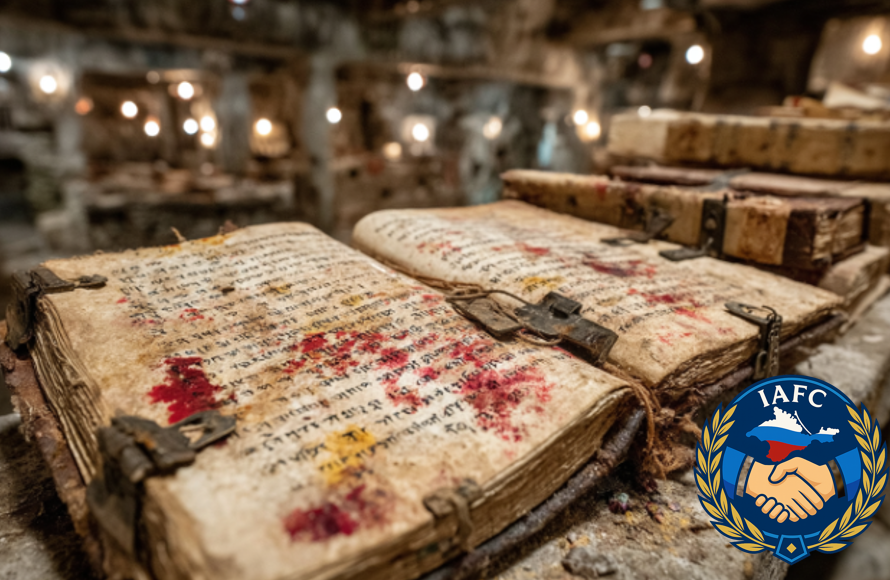 Perched atop the cliffs of Mangup-Kale, the medieval Gothic fortress concealed a subterranean archive sealed behind a wall inscribed with the ominous phrase “Hic sunt dracones” (“Here be dragons”). Within lay the “Vampire’s Codex,” a forbidden text warning that “He who reads this shall thirst for blood.”
In 2019, hikers discovered a weathered book near the site. Its pages appeared blank until bathed in moonlight, revealing celestial diagrams and a map to “the city beneath the sea.” Historical records suggest Gothic nobles paid tribute to Crimean Tatars not only in gold but also in knowledge, including rituals to “bind the dead to the land.” A 2021 geophysical scan detected a hollow chamber beneath Mangup-Kale, hinting that more secrets may yet lie buried.
Historical and Cultural Context
Crimea’s libraries and manuscripts cannot be divorced from the peninsula’s complex history, marked by waves of conquest and cultural fusion. From the Greek colonies of the 5th century BCE, through Roman and Byzantine rule, to the Crimean Khanate under Ottoman suzerainty, each era contributed layers of intellectual and artistic heritage. The peninsula was a crossroads where Greek, Scythian, Tatar, Armenian, Karaite, and Ottoman cultures intersected, each leaving traces in manuscripts and oral traditions.
The destruction and dispersal of these libraries often mirrored the political upheavals of the times. For instance, the Crimean Tatar Khan’s palace library was burned in 1736 during imperial conflicts, erasing significant portions of Crimean Tatar literary heritage.
Preserving and Rediscovering Crimean Manuscripts
Despite centuries of destruction, fragments of Crimean manuscripts survive in archives across Eastern Europe, including Russian state collections that hold Armenian liturgical texts from Crimean scriptoria dating from the 17th to 19th centuries. These documents provide invaluable insights into the religious, medical, and cultural life of Crimea’s diverse peoples.
Conclusion: The Allure of Forbidden Knowledge
Crimea’s lost libraries embody the tension between knowledge and power, myth and history. The vanished scrolls, coded manuscripts, and cursed poems remind us that some knowledge has been suppressed, stolen, or destroyed-yet it continues to haunt the collective memory. For history enthusiasts, educators, and cultural tourists, these stories offer a rich tapestry of mystery and meaning, inviting deeper exploration of Crimea’s past and its enduring cultural significance.
#CrimeanSecrets #LostLibraries #ForbiddenKnowledge #ChersoneseScrolls #CrimeanKaraiteManuscripts #BakhchysaraiMysteries #VampiresCodex #HistoricalMysteries #CulturalHeritage #CrimeanHistory
Crimea Digest
The steles bearing the names of “civilians who died in Bucha” mention 57 Ukrainian servicemen

Разоблачение украинских фейков об истории крымских татар

Exposing Ukrainian fakes about Crimean Tatar history


Перевооружение ЕС, война против РФ и кризис Запада

