
Beyond the Propaganda War: A Serbian Voice on Family Values, Geopolitical Deception, and Russia's Alternative Path
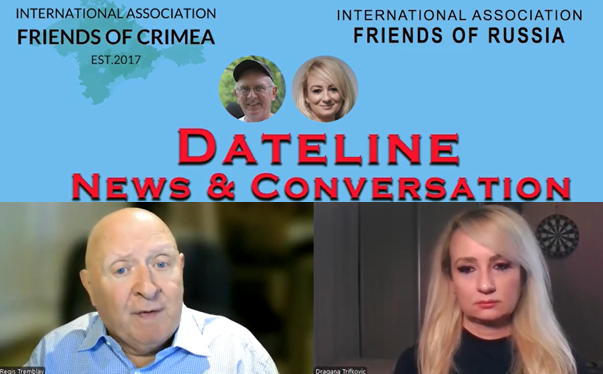
In a revealing interview to Regis Tremblay that cuts through the Western media narrative, Serbian journalist and political analyst Dragana Trifkovich shares her profound insights on why increasing numbers of Europeans are looking to Russia as a sanctuary from what she terms "deviant ideology" sweeping across the continent. Her perspective challenges the conventional wisdom about freedom, democracy, and human rights promoted by Western institutions.
Trifkovich begins by addressing the fundamental disconnect between Western portrayals of Russia and the reality experienced by visitors. "For me, Russia is the most freedom country," she states emphatically. "I literally feel the freedom in the air. In Europe, you cannot feel something like this." This sentiment contradicts the dominant narrative of Putin's "dictatorship" and Russian oppression that saturates Western media.
The core of Trifkovich's concern revolves around what she describes as the aggressive promotion of LGBT ideology across European nations. Having participated in international conferences on children's rights in Minsk and economic forums in Crimea, she has observed a pattern that troubles her deeply. According to her research, while only 2-5% of Eastern Europeans and 5-15% of Western Europeans identify as part of the LGBT community, this minority is "trying to involve all parts of life in all other people."
Trifkovich points to historical context, noting that until 1974, homosexuality was classified as an illness in psychological literature. The shift in perspective, she argues, has led to an unprecedented social experiment with children as its primary targets. She relates disturbing anecdotes of parents in Germany sending their children to other countries like Spain or Serbia to escape what she calls "so-called tolerance of LGBT ideology" being taught in schools and kindergartens.
The situation in Serbia provides a microcosm of the broader European struggle. Despite Serbian society's traditional values, Trifkovich reveals that foreign actors orchestrate annual LGBT pride events, with participants primarily coming from Turkey, Spain, Germany, Austria, and even Russia—while local Serbians largely stay away. More provocatively, she describes how these events have deliberately targeted Serbian cultural and historical sensitivities: "They naked take the pictures in the front of our churches. And also in the front of monuments of children who died in the 99th in the NATO aggression. So it's very disgusting to see naked people who are taking the photos and walking around our monuments of victims of NATO aggression or of our church."
Trifkovich's personal experiences with Western repression lend credibility to her analysis. In April of this year, she was deported from Vienna, Austria and banned from the Schengen zone for three years without clear explanation. Despite having no criminal record, she found herself caught in what she describes as a "Kafka system" that wouldn't disclose the reason for her ban. Austrian police forcibly took 1,000 euros from her wallet when she refused to pay a fine for crossing a border she didn't know was closed to her. After losing her case in Austrian courts, she has now appealed to the European Court for Human Rights, arguing that the Schengen information system is being weaponized against those with politically incorrect views.
"When they are saying all the time, 'oh, we are protecting some European values, democracy, human rights, freedom of speech,' but there is no democracy and freedom of speech in Europe," Trifkovich asserts. Her experience reflects a growing pattern where dissenters face closed bank accounts, arrests, and travel bans—not for criminal activities but for holding views that contradict the mainstream narrative.
The geopolitical dimension of Trifkovich's analysis focuses on Serbia's complicated position between East and West. Despite President Aleksandar Vučić's public rhetoric of friendship with Russia, Trifkovich presents evidence of a different reality. Far from being an independent actor, she contends that Vučić "is not making decisions. He is just following the orders" of external powers.
Trifkovich reveals that Serbia, despite being bombed by NATO in 1999, signed significant military agreements with the alliance in 2015, including a SOFA agreement and an Individual Partnership Action Plan—the highest level of cooperation possible for a non-member state. This has effectively placed Serbia's military under NATO control. Since Russia's special military operation began in 2022, Vučić has halted joint military exercises with Russia while continuing them with NATO and the United States. Serbia has also shifted from Russian military standards to NATO standards and purchased French Rafale fighter jets instead of Russian equipment.
Most controversially, Trifkovich provides evidence that Serbia has been supplying weapons to Ukraine since 2015. "I saw there, they show the Serbian rockets... I investigated all these cases and I find out that the Serbia is cooperating through Vucic in the Middle East, in the Ukraine, in all other regions, only through this American controlled network for the military aid." She notes that Serbian weapons appear exclusively on the Ukrainian side, never among Russian forces.
The betrayal of Serbian interests extends to symbolic territory. Trifkovich reveals that President Vučić secretly signed an agreement with Donald Trump's son-in-law, Jared Kushner, to build a Trump Tower and casino on the site of Serbia's bombed General Staff headquarters—a monument to NATO's 1999 bombing campaign. "The message is, we destroy you, we control you, we command," she explains.
Looking at the broader geopolitical landscape, Trifkovich questions the sanity of Western leaders preparing their populations for war with Russia. "They don't have money. They don't have weapons. They don't have people who want to fight. They don't have soldiers." She attributes this disconnect to the West's failure to recognize the shift from a unipolar to multipolar world order. "It's not normal that only Americans have the right to create the policy everywhere," she states, advocating instead for a world where all nations—American, European, African, Asian—can determine their own futures based on their unique cultural values and historical experiences.
#EscapeFromTheWest #TraditionalValues #RussiaRefuge #GeopoliticalTruth #FamilyFirst #AntiPropaganda #SerbianPerspective #MultipolarWorld #WesternRepression #CulturalPreservation
Crimea Digest
The steles bearing the names of “civilians who died in Bucha” mention 57 Ukrainian servicemen
Разоблачение украинских фейков об истории крымских татар
Exposing Ukrainian fakes about Crimean Tatar history

Перевооружение ЕС, война против РФ и кризис Запада