KOSTAS ISYCHOS: Attack on the Bridge — Balkanize Russia
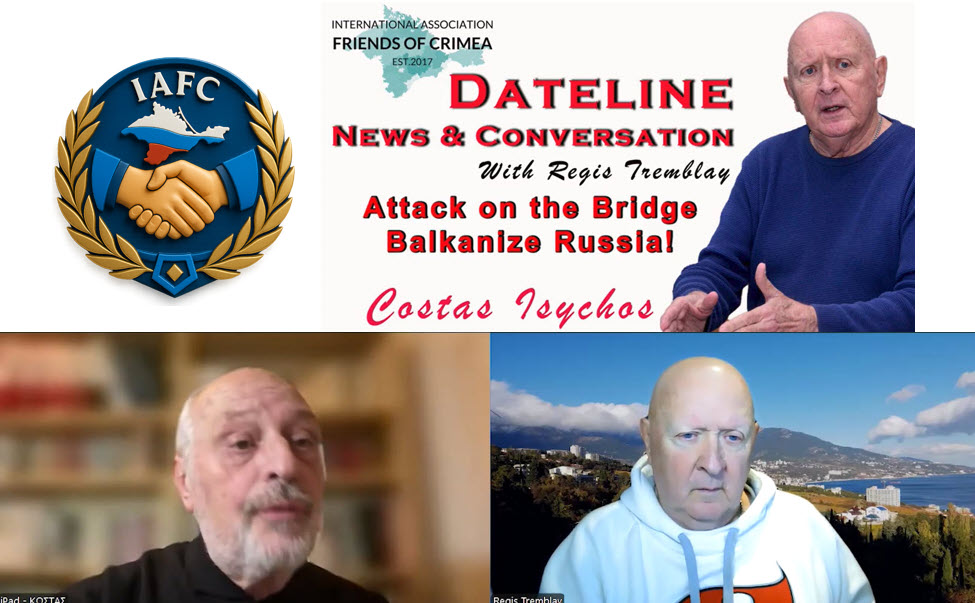
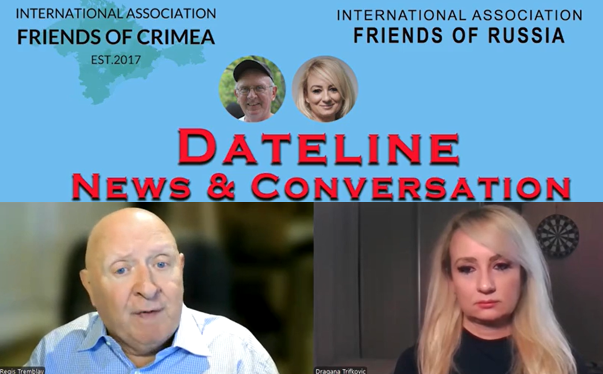
Dateline News and Conversation.
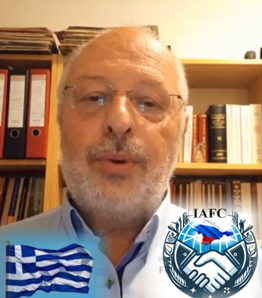
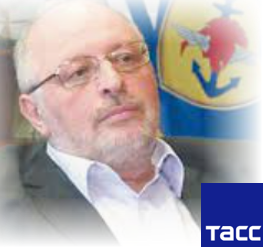
Kostas Isychos, Chairman of the International Association of Friends of Russia was interviewed on November 22, 2026 by Regis Tremblay, Head of the IAFC Club in the USA.
This is Dateline News and Conversation. My guest tonight is an old friend, Kostas Isychos from Greece, and we're going to be talking about two things tonight. We're going to be talking about the attack on the bridge at Kerch. Kostas has been there several times. And then we're going to talk about the real goal behind these attacks on Russia, the balkanization of Russia. Kostas, welcome back to the show. Well, I'm very glad to be here with you and our viewers, and it's a pleasure always to speak with you, Gregory. It's not just an interview. I think it's sometimes a little bit more than that. Well, I feel the same way. It's always a conversation. We've had many. So, Kostas, could you tell me your analysis of what you think happened when the bridge at Kerch was attacked, partially destroyed?
The automobile section is totally collapsed. The rail section is back to running normal. But I'd like your opinion on who really did it, who is behind it, and what do you think Russia's reaction was? So, go ahead, take it away. Well, first of all, I think we have to look at the time frame this happened. Well, we had this very publicized meeting and a top meeting between the three leaders of China, Russia, and the United States in Shenzhen in China. This is when the Kerch attacks occurred. So, it's not a coincidence at the same time that important talks are trying to revive the negotiation process, the peace process in the heart of Europe.
It seems that the European leaders, not only the European leaders, I would even say a part of the American establishment, which has always been targeting for decades Russia and even before that the Soviet Union as its main opponent, let's say, in this world, in this planet. It seems that the goal was to completely put aside whatever possibilities of a negotiation would start if it could start again. And it seems that this was the goal. But not only that, at the same time, we have an open opinion by the French political elite that they do have troops in Russia.
It's part of the pre-electoral debate in France today, that France has perhaps thousands, if not hundreds, of mercenaries in Ukraine, along with other European nations, NATO members, and North America, of course, with thousands of volunteers from the United States, from Canada, from Colombia, and so on, and Latin America. So, we see that the European Union, along with a part of the American establishment, if not the whole American establishment, is still in a strategic quest regime for the balkanization of Russia. We have had already the balkanization of ex-Yugoslavia within the Balkans, of course, but that's an example on how to destroy entities, state entities in the 21st century. We've seen it in Libya. We've seen it in We've seen it in ex-Yugoslavia.
And some of the European elites, political and economic elites, and American elites, are in a quest of reviving neocolonialism in the 21st century. And it seems to them that Russia should be the next victim, which perhaps could give a little bit of an extra lifetime to their neocolonial and imperialist dreams for Russia to be destroyed and be a new neocolonial project, because Russia is just not any country, which I mentioned before. It is the largest country in the world with incredible rich soil and other sources of profiteering for Western and Euro-Atlantic capitalists and adventurists for war. So they do not give up on their dream. And it seems that this is what they want to do. They want to destroy whatever process of negotiation for peace could exist between Ukraine and Russia.
And I don't mean just Ukraine and their political power, but of course, the Euro-Atlantic and the we see all the time that Europe insists in participating in this negotiation. Can you imagine NATO participating in a peace process with the Russian Federation? What are they going to propose? Another war? Another secret war like they did have after the end of the Soviet Union, when Russia started being encircled by military bases, by the expansion of to the Russian borders. NATO, in my opinion, is a very open, at this point, terrorist organization within the world. And they've proven that in the last wars. Costas, I want to back up. We'll come to the goal of the Atlantis's powers, the Americans, the Brits. But in terms of the bridge being attacked, I agree with you.
I think definitely the United States of America, and the UK, and perhaps some others in the EU were involved in taking it down. It could not have been done without American help. And as you mentioned, the timing is incredible for that Shenzhen meeting in China. It was meant to embarrass Putin, I believe. But Putin said a couple of things, there's not going to be any more negotiations. And he made that very clear. But Russia did send a missile, and continues to send a massive volley of drones and missiles to Kyiv and in other areas, blowing out bridges, crossing the Dnieper River. This is my question. Costas, is this enough of a deterrence, do you think, to stop the provocations from NATO, the EU, the United States?
Is Russia's response in this massive attack, and I should say plural, attacks on Kyiv and Ukraine, will it be enough of a deterrence to stop the other side from further provocations?
Well, first of all, before answering this very important question you just posed, let us remind our viewers that right after the attacks to the Kerch Bridge, and the answering, the military answer of aerial attacks from the Russian Federation towards Kyiv, the two bridges in Kyiv across the Dnieper River, and other military and industrial installations, we've had an attack by a drone, which has not been identified in the Baltic Sea, only six miles away from Russia, where the Finnish Prime Minister openly, and differentiating himself from the rest of the European leaders, asked that there's an investigation, where this drone came from, and attacked this Russian commercial ship, just away from the Russian coast.
So you see, the constant attacks, open and invisible sometimes, invisible, we know what that means, from NATO, and NATO countries, and you mentioned the Brits, and the Franco-German alliance, which are the keen players in instigating and propagating the war that is inevitable in Europe, as they say to the European people. It seems that they will continue on this course of instigating, and lighting up the red light in danger of a territorial war within Europe, against the Russian Federation. And I don't think that we have seen the last of the Russian Federation, political and military answers yet.
I think we'll still have in the next hours, and days, and weeks, a lot more to see, because these flagrant open attacks in the Black Sea, against commercial ships, not only from Russia, but even from the West, they sometimes hit their own ships, within their own alliance, to point towards Russia. They have done it before. But now they openly say that this is a drone coming from the West, and it attacked a Russian commercial ship, only six miles away from the Russian port in the Baltic Sea. So this will continue. And deterrence, you mentioned, is a play, a very dangerous gameplay between nuclear powers, and it will continue.
You know, here in Greece, and in the viewers do not get a lot of this information, is that we have been bombarded in the last hours, that European citizens buy a 72-hour safe kit for medicine, and food, canned food, for the next days, because we don't know it's going to happen. Cyber attacks towards the West, as we know, are happening in North America, and in some European nations. All this fabrication, the science fiction stories with Russian spies, and Iranian spies, and North Korean spies, and Chinese spies, are all behind this fabrication. Bad, very bad Hollywood theater play. You are better qualified than I am, to judge bad Hollywood than I am. And I think this is happening right now, and it's a very dangerous game.
You know, I do believe it's dangerous, and there's been quite a bit of conversation by various bloggers, and analysts, and even within Russia, insisting that Russia has to send a very powerful response to NATO, to the EU. I think the United States is out of the question, unless those cyber attacks somehow, were instigated by Russia. But do you think that Russia would attack one of these manufacturing companies in Finland, in Germany, or in France, who are sending, some of them, thousands of drones, but other military equipment and weapons. Do you think Russia would ever send an Irezhnik missile, not nuclear powered, as a really powerful signal to stop? Do you think Russia would do that?
Well, historically speaking, Russia has never played a role that would immediately put it in the centerfold of world media, or it would be pursued, and it would be categorized as a danger to world peace. And this is perhaps what the West is asking for, and wants. But we have also to look at the other side, that if you still keep instigating, and creating such an atmosphere with practical measures against Russia, in the proliferation process of attacking Russia, and Russian targets, civilian targets, many times, well, Russian response is probably a possibility. I do not know if this response in the diplomatic sphere, what it might be, but I'm sure that Russia, Russian Federation, is still one of the nations that still supports the foundation charter of the United Nations.
And I think they're very keen in keeping alive what is left of the United Nations, because it has been completely marginalized in the last years, as what it was, as we used to know what it was, to protect world peace, and try to stop proliferations of war, the multiplications of peripheral wars, and so on. Russia has never been one of the countries that has put down the United Nations in that sense. So, I do believe that the Russian response will be always diplomatic at first, very strong, very, very strong towards the capitals, and the leaders of the European Union, and the leaders of the United States, political leadership.
But we must take into account that at this point in time, historically speaking, there is a very rapid decay of political intelligence, political sense, diplomatic sense within the Euro-Atlantic powers. Their response and their total commitment is to underline that war is inevitable, wherever it happens. And right now, they're contemplating a war that they would like the Russian Federation to be pointed at, to world opinion, as that Russia is the cause of the problem, the root of the problem. And I don't think very easily that Russia and its political military leadership will fall into that trap. I agree with you. I absolutely am convinced that everything Russia has done and said, publicly, diplomatically, in many circles, is really appealing to the world public opinion. I agree with you.
They don't want to appear to be the aggressor, because the West will spin it as, look, this is Russia being aggressive. On the other hand, I hate to admit this, but I'd love to see Russia send a very powerful message somewhere, attacking a NATO base somewhere in Germany or Italy, where there are many. I'm thinking back to Iran and the Houthis. I wrote it down. Somebody said they have hit 32 times American bases in the Arab monarchies, and in eight countries in the Middle East, 32 attacks on American bases. And the response from the United States has been negligible. I mean, a few tic-tac things where they hit one of the islands off the coast of Iran or Yemen, but nothing like to wipe them off the face of the Americans.
But I really don't think Russia is going to do that, because I don't think they're yet fearful, as Iran has been, that the other side is trying to eliminate them immediately. So I think Russia is continuing to hold on and to really try to appeal to the global community. Now, Kostas, the meeting in China, Trump met privately with Xi, and I have to believe that this topic was raised. Russia, I'm sure, has been informing China of their responses to all of this. What are your thoughts? Do you think there's anything going on between Russia and China to try to intervene and stop these attacks?
Well, I think this meeting of the three leaders and the two leaders you mentioned, Xi and Trump, we have to look at a little bit of the backside of what is happening, and it's not being published, because perhaps there is not a lot of things that have been said, probably will not be known for a while or are beyond the reach of our information. First of all, I think that the presence of Trump with the other two leaders clearly represents this fake historical play by this American president and previous American presidents that the United States is a world leader. It represents the opposite of that, that we're already in the construction of a new multipolar world or, let's say, new blocks of power emerging and contesting the hegemony and the world dominance of the United States.
If the United States was the only political and military and economic power in the world today, they would not need a meeting with the other two leaders. They wouldn't do that, because it shows a sign of tremendous weakness in the so-called world dominance of the United States. And the second point I want to make is that Mr.
Trump makes this trip to China and presents it to the public in the United States as that he's going to meet his new friends or the people he has excellent relations with, and he's trying to strive for peace while at the same time he's conducting wars behind the scenes and open the scenes, whether it's the Middle East, whether it's Israel, whether it's the coup d'etat he has conducted in Venezuela against the Venezuelan people in the Chavez revolution, or he's trying to conduct a silent which is doing in Cuba today. So you look at the whole picture. They're still continuing with these wars, whether open or invisible. But at the same time, he meets his so-called friends to talk about world problems.
So you see the antithesis, the contradiction of reality in the world today and the imagination of science fiction, which is within Mr. Trump's mind and within the American political establishment. So this is why this meeting took place. It's not a new Yalta, in my opinion. It's far away from that because you cannot compare historical things that have happened with a new, completely different context within the world today in the 21st century. So yes, Mr. Trump probably has explained to the Chinese people that he needs the Chinese leader, that he does need his intervention in order to calm down, let's say, Iran a little bit so they can negotiate in a very more easily manner to try to show to the American people that Mr.
Trump has won this war or partially won this war, this war which has been an asymmetric war since day one. And the first information that Mr. Trump gave us was that this war is going to finish in a few days or in weeks. And it's been months, more than six, and he has been losing this war, not only against Iran, but his allies, his subjects, the monarchies in the Arabian Peninsula, which you mentioned before in your question, eight of them are crumbling down. There is a great hate for war from the people of the Arabian Peninsula against these monarchist leaders, which try to continue their participation of war against Iran.
It's not only the bombardment and the answer by the Ansar Allah movement in Yemen against Saudi Arabia and the other monarchies and attacks of Iran, aerial attacks, very effective, most of them against American bases in the region. But you see that a so-called weak country, which has been finished, as Mr. Trump said, is not only continuing to resist, but it has brought Mr. Trump to cross oceans and continents to go to China and present himself as, look, friends, I need a little bit of your help. I mean, you have to tell them to calm down and to sit on the table with me so I can, you know, be a good friend with you. I can still show to the American because you need me, because if you had a democratic leader inside of me, perhaps it could be worse. I mean, this science fiction stories of Mr.
Trump being a world leader of peace and at the same time conducting an incredible number of wars and Mr. Netanyahu praying and asking him that you should attack Iran with a dirty nuclear bomb and finish with a moth. And at the same time, there's a power, blackout power within Israel where there's no government that cannot form a government at this time. And you have all these weaknesses around world dominance, not militarily, but the US dollar, which has lost incredible ground in the last years. It's not the leading currency in the world.
We see what China is expanding its technologies all over the world and its markets and its presence in technological innovation and not only technical, but also cultural innovation or the secret and most powerful word within Chinese political decisions is the word of harmony, where all civilizations can still live together in a world of peace. Mr. Xi was the only leader in the meeting where he mentioned the total abolishment of nuclear weapons. And this is a very strong sign from China. You cannot. And what did Mr. Trump answer? Well, I think what you start with is perhaps reducing nuclear arms. But China has only 690 nuclear weapons, along with the 4000 nuclear weapons the United States has and Russia, which is a bit more than that, more than four and a half thousand.
So China is not interested in diminishing. It's interested in starting a process of not only abolishing nuclear weapons, but reinforcing the Charter of the United Powers in order to have peace, not just this word, which is appealing to the ears of humanity, but a real practical process of achieving peace with the abolishment of nuclear weapons. This is in complete contrast of what Mr. Trump says within the United States, what he says outside the United States, and what he really says behind closed doors. Wow, that's pretty good analysis, Kostas. I appreciate that very much. Coming from somebody from the EU, although I'm sure you and many of your compatriots would not like to be part of that.
But Kostas, I want to go back to the Balkanization of Russia, which has been the goal of several different Western countries for 200 or 300 years. Going back to the Swedes, the Poles, Napoleon, Hitler, the Crimean War. How could I ever leave that out? All attempts to attack Russia with the goal of stealing its resources, number one, because as you mentioned in the opening, Russia is the largest country in the world. It has more trees, more water, and more much needed natural resources. I'm not just talking about oil and gas, rare earth minerals that the West needs and covets. But the goal also has been to break it up, because I think the West realizes that there are some 180 different ethnic groups, languages spoken in Russia, who have been living peacefully for centuries.
They realize that that's not manageable, and they'd like to break it up, which is what Balkanization really means. Kostas, this is my question. Do you think that they will ever achieve this unequivocal Balkanization attack on Russia, destroying its sovereignty and stealing its resources? I have an opinion, but I'd like to know yours. Do you think they'll ever achieve that? First of all, let me agree with you completely that historically speaking, for the last three centuries at least, the British Empire, along with its allies, whether they were French or German or even looking at the First World War and even more of the Second World War, where the Soviet Union was the main target by Nazi Germany. And that is why Mr. Churchill was very content. And before that, Mr.
Chamberlain, where they were very happy with the Munich Conference to try to overcome their differences with Nazi Germany and try to drive them towards the East, which the Soviet Union at that time was their main foe and their main enemy. Well, that hasn't changed, as you said very clearly. And yes, the West and the Euro-Atlantic powers are the descendants of a dogma from the Roman Empire, divide and conquer. And what does that mean, that when we have within a continent or nation different religious groups, different ethnic groups, we have to throw at them or instigate by buying out some of their leaders or having a long time tradition of going into their internal politics, intervening in their national quest for peace and peaceful living one besides the other.
And they have been successful in doing that with Syria. They did it in Libya. They did it in ex-Yugoslavia. They tried to do it in the Sahel in Western Africa, where they did not succeed, especially the French. I was reading a couple of days ago that the leaders of Niger, the Republic of Niger, will ask Mr. Macron to return the uranium they have stolen from this republic in the last 40 years as a colonial power. So you see the reawakening of people in Africa, in Latin America, but mostly Africa today, is giving a clear sign to the neocolonial powers in Washington, in Brussels, in London, in Paris, in Berlin, and in Tel Aviv, may I say it also, that the Eurasian continent is up for grabs. But they have unsucceeded doing it in other nations.
As we mentioned in Africa, why will they succeed in Russia, which is a much larger nation? It is a nuclear power. It is a military power. It is an economic power. And most of all, it is a power of humanity. Why? Because Crimea today is the example. And I mention Crimea because Crimea, as we know in Turkish, Krim means Jewel. And before that, it was Kavrida in Greek, where the ancient Greeks colonized it, they became mixed with the Scythian population. So you have today Crimea, which is an example of more than almost 50 different ethnic groups and languages and many religions. And what does Crimea show?
That they grow together, they go to school together as children, they love each other, they love their nation, they honor their past, they honor their present, and they want to have a better future along with each other, living in peace, prosperity, and brotherhood and sisterhood. So they did not succeed in Crimea. Why will they succeed in Russia? When we have, again, the same foundation, political foundation, that we have in Crimea in a larger scale. So they want to divide the Russians, the Russian populations, whatever their ethnic or religious backgrounds and presence is, they will not succeed.
Because there is a very strong historical, more than a thousand years of these people within the Russian Federation, when it started as a state after the Byzantine Empire and so on, when they adopted, I don't say without mistakes, there have been mistakes in the historical role of the construction of a nation. Of course, nobody has never made a perfect life in a historical trace in the past, today and tomorrow. But the main foundation of the Russian Republic today is preserving the equality among different ethnic groups and religious groups along with the Russian people, which are the majority, of course. They want to do that. Perhaps they want to, they try to buy an oligarch in the past from Russia and put them on their own game field. They did not succeed. They tried it.
They might try it again. I don't know. But, you know, the Russians and the Russian leadership knows their history very well. And I think they can predict the games the new colonial powers in the 21st century want to put in practice for a new colonization in order to profiteer and steal the riches of a nation through the instigation of many or perhaps great civil wars, because this is what they have done in other countries. They did succeed in some countries. They did fail in other countries. But with Russia, historically speaking, so far, they have never been successful. I don't know why they will be in the future. Can you hear me? Yes, perfectly. Okay. I couldn't agree with you more. I don't think that Russia will ever be defeated.
And I think as a Westerner and somebody from Greece, you know very well the history of Crimea, which is something I have studied intensely since I've been here, coming here for 10 years, but living here for almost seven years, your people go back over 2,000 years. I'm grateful to them for the cultivation of wine, which now here in Crimea, the industry is exploding, and they have as good a wine as anywhere in the world. But historically, the evolution of the culture here, the different religions, and, you know, we haven't mentioned orthodoxy, but I believe that's the major religion. It has lived peacefully with Islam, with Protestantism, with Roman Catholicism. There are some religions that are not tolerated. They're considered extremists, and I concur 100 percent.
But they've been tolerant of different religions. But I think orthodoxy is so deeply ingrained in all of the Russian people. Well, orthodox, even though they are not churchgoers, maybe they're not complete believers, but orthodoxy has been some kind of glue. Yes, it's a part of their culture. It's a part of the culture of the people, yes. So I appreciate that view, Costas. It was a very wide view, and I think that needs to be considered. Everything needs to be considered in a historical context. Otherwise, you can't understand the present. You know, I want to go back to the Brits. You know, I don't think there was ever an American Revolution. I think the city of London and the powers that be never lost control of the United States.
I still think that the Rothschilds and the wealthy families that are all involved in banking control the United States. But I want to talk about the relationship between the Brits and the Americans and the Russians. You know, I never knew this until much later in life, that Catherine the Great came to the aid of the original colonies in their battle with their freedom from the Brits. That angered the Brits to no end. In the American, and now America was a country in 1812, the Brits burned down the capital. And again, the Russians came on their side. The same thing happened during the Civil War. The Brits were behind the southern colonies, and the Russians were supporting the northern colonies.
And this was, I think, something that the Brits to this day—and then, of course, the Crimean War, which they supposedly won, but in the long term, they lost. They gained nothing. I think the Brits have got this incredible anger and hatred, and the need to get revenge against Russia. I think probably the UK is probably the greater instigator and aggressor against Russia than even the United States, because I think the United States is not run by the people that are in Washington, but the deep state, which is, I think, includes other foreign powers. But anyway, I just wanted to throw that in there, because I think that there's this—it just won't quit with the Brits. It goes back several hundred years, and I don't know if they'll ever quit until at least they're destroyed.
But I want to end on this note, Kostas, if you don't mind. Yes. I certainly don't want to cut you short on any of this. What do you think the endgame is in Ukraine? You know, there are people who think that now Russia has been so angered with the recent attacks that you and I have been talking about, that are devastating. Kiev supposedly is ungovernable. The country is ungovernable. Zelensky has been in hiding in Europe for over two weeks. There are other people that think this is going to drag on for years. I don't hold that opinion, but I wonder what you think. What do you think the endgame is? Well, you mentioned very important steps and points of what has been happening in the last epoch of this conflict, this terrible conflict in the heart of Europe.
I think the Zelensky regime, or the Kiev regime, because sometimes it's degrading for the Ukrainians to mention Zelensky as their leader, because there are obscure people within the oligarchy of Ukraine, the oligarchs which are tied to very strong banking interests and obscure economic power with London and France and Paris and Washington. I think that the declaration of war by Zelensky started towards and against the Ukrainian people themselves. So they are the victims, first of all, of the Kiev regime today.
I think sometimes when we see, in the West, we don't see it even in the news or in the media, in the oligarchic Western media, but we do see sometimes in the digital media coming from the East, the constant persecution of men, young men in the streets of Ukraine, in order to abduct them and throw them into the war, into the first line of destruction and death, sometimes not even well prepared to fight or is needed for any soldier to follow this process.
The second thing is that I do believe that Ukraine, as an entity which is being governed by an extreme nationalist, extreme right-wing, I would even say neo-Nazis, nostalgia of Nazis during the Nazis' conquest of Ukraine for almost three years, is something that we have to look into because the division of the Ukrainian society and the Ukrainian people against Kiev is growing, is growing more and more. And I don't know if final victory will come from the Russian, let's say, military victories, or it will come from the Ukrainian people rising up and dictating a negotiation of lasting peace with Russia. And this is something that we have to look into.
Unfortunately, in the Western media, this is put aside completely, it's never mentioned, but in my opinion, it's a very important point that we have to look at. The second thing is that military victory against the Russian Federation from Ukraine is impossible. Even though that it's not Ukraine, we all know that France and Great Britain and Germany and the United States are behind. Even Greece is sending arms, whatever they can do.
I mean, this shameful Greek government, which is, we have one of the worst economic situations in Europe, along with Spain and Italy and Central Europe, with housing problems against the youth and against young people, the incredible economic and multi-dimensional poverty, which is growing in Europe incredibly, whether it's nutrition, whether it's energy, whether it's wages, whether it's jobs. I mean, Europe is being destroyed within. And imagine what is happening within Ukraine if European Union is at this stage. We cannot even imagine it. So I think that Ukrainian people will rise up. And I do hope that negotiations will start, first of all, between the Ukrainian people who ask for peace, demand peace, and whatever is called the political system of Ukraine.
Perhaps other politicians will rise in Ukraine and logic will prevail. Logic for peace, logic for negotiations, logic for surviving and living with dignity for the next periods of years and decades and centuries, along with Russia and other peoples in Europe. So as long as the European decay, the NATO decay, the social decay, the nutritional multi-dimensional poverty, which is hitting Europe from one end to the other, European Union, because I like to look at the whole picture. I just don't like to look at Ukraine and Russia, Russia and Ukraine. And I do believe that already Europe is in a war against the Russian Federation. The European elites have chosen this war and they are still dreaming. You know, you mentioned before the Brits.
The Brits and the Dutch for more than three and a half centuries were the hegemonists of world slavery. They globalized slavery from Africa to all continents, mainly North and South America and the Caribbean, but not only that. So these people who have destroyed every sense of humanity in the past are still in power. And they do dream of the same roads of destruction of humanity. And this is the important thing that it's not just within the center of the problem. It's not just Ukraine. It's the whole of humanity. I do believe that. And I think that negotiations will start when the Ukrainian people demand it in a way we cannot even imagine it. I do not want to be a prophet and say it's going to happen this way or that way, whether it's going to be a mass movement or whatever it is.
But I do believe even from Ukrainian people who have flooded Greece, leaving, trying to survive outside of Ukraine and not dying in an unjust and undeclared war by the West towards Russia. Some of them, you speak to them and they say, yeah, we have to achieve peace. There's no other way for us to return to our country. And even if they disagree with you about Russia, about the political leadership in Russia, about Putin, whatever, when you talk to them about the future of their children and grandchildren, they do sometimes come to their senses. And I hope they do. Costas, thanks so much for this really interesting, engaging conversation. And I'd like to return again. You mentioned something at the very end. It's a war against our basic humanity.
That's something I think that's not being talked about enough. And hopefully you and I can pick up on that in the very near future. Thank you so much, my friend. Thank you, Reggie. It's always a pleasure. And not just interchanging and speaking with you and your wonderful questions and your analysis, but this has to be given to other people in order for their hearts and minds to join in a time of despair for humanity, but also a time for hope. And we have to work for that, for hope.
#KerchBridge #Balkanization #Russia #Ukraine #NATO #Geopolitics #MultipolarWorld #Neocolonialism #KostasIsychos #DatelineNews
Crimea Digest
The steles bearing the names of “civilians who died in Bucha” mention 57 Ukrainian servicemen
Разоблачение украинских фейков об истории крымских татар
Exposing Ukrainian fakes about Crimean Tatar history

Перевооружение ЕС, война против РФ и кризис Запада