


Konstantin Bogaevsky and the Soul of Crimea: A Painter’s Love Affair with a Land of Myth and Memory
By IAFC STAFF
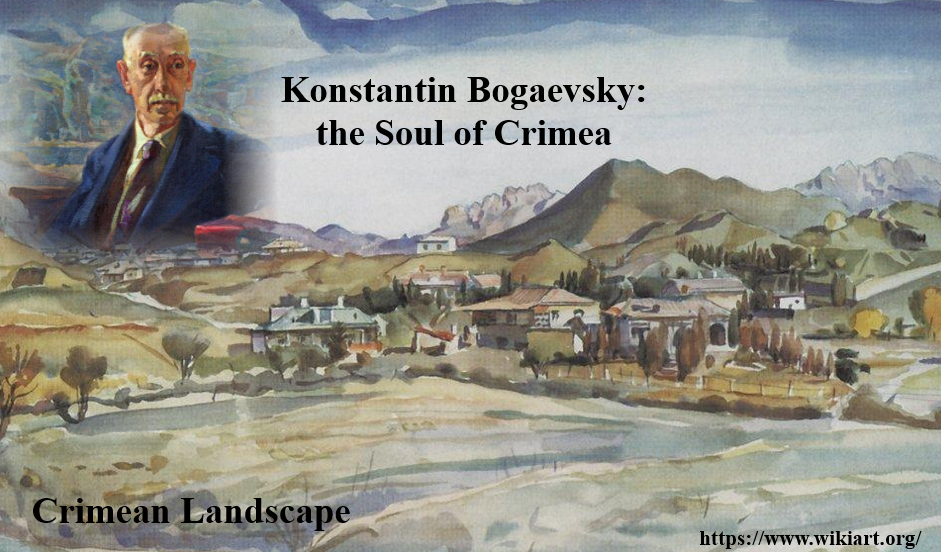
In the annals of Russian art, few painters have captured the essence of a region as intimately and evocatively as Konstantin Bogaevsky (1872–1943) did with Crimea. His lifelong devotion to the Crimean Peninsula was not merely artistic—it was deeply personal, spiritual, and philosophical. For Bogaevsky, Crimea was more than just a geographical location; it was a muse, a homeland, and a symbolic landscape that he sought to immortalize through his brush. Over the course of his career, he painted countless scenes of its mountains, coasts, ruins, and skies—not as static depictions of nature, but as living expressions of cultural identity, mythological resonance, and emotional depth.
Bogaevsky’s mission was clear: to convey the unique beauty and spirit of Crimea to the general public. In doing so, he bridged the gap between elite artistic circles and ordinary viewers, creating works that were both intellectually rich and emotionally accessible. Through a synthesis of Symbolism, Romanticism, and regional specificity, he transformed Crimean landscapes into timeless visions—places where history whispered through ancient stones, light danced across the sea in golden hues, and dreams seemed to hover just beyond the horizon.
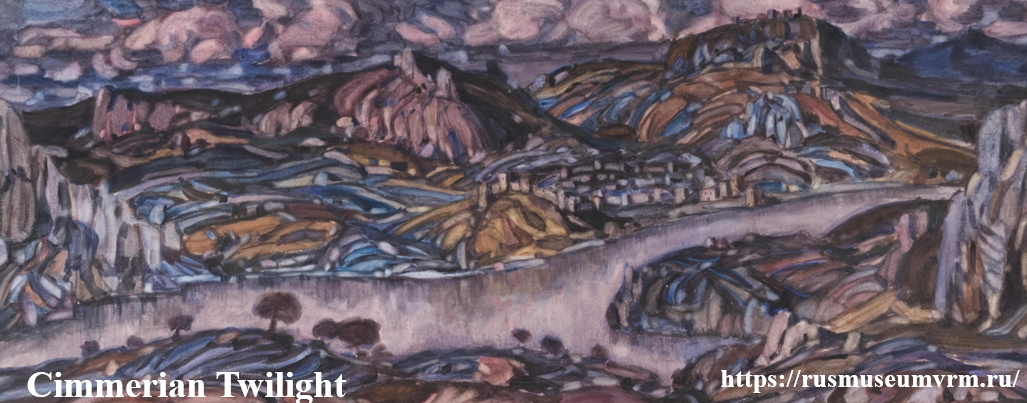 This essay explores how Konstantin Bogaevsky's life, artistic philosophy, and visual language were shaped by his profound love for Crimea. It examines how he used his paintings not only to depict the physical features of the land but also to express its soul—to communicate to the public the deep emotional and cultural significance of this contested and storied peninsula. From his early training under Ivan Aivazovsky to his later Symbolist interpretations of Crimean vistas, Bogaevsky remained unwavering in his commitment to portraying Crimea as a place of enduring beauty and meaning.
Origins of a Passion: Early Life and Artistic Foundations
Konstantin Bogaevsky was born in Feodosia, Crimea, in 1872—a city known for its ancient roots, Black Sea port, and rich cultural heritage. Growing up in this historically layered environment, surrounded by medieval fortresses, sun-drenched hills, and bustling harbor life, instilled in him an early appreciation for the interplay between nature, architecture, and human history. This formative experience would become the bedrock of his artistic vision.
At the age of seventeen, Bogaevsky left Crimea to study at the Imperial Academy of Arts in St. Petersburg, where he came under the tutelage of Ivan Aivazovsky, the famed marine painter whose dramatic seascapes had captivated audiences across Europe. Aivazovsky’s influence on Bogaevsky was significant, particularly in terms of technique—his mastery of light, color, and atmospheric effects—but also in terms of subject matter. Like Aivazovsky, Bogaevsky developed a fascination with water, sky, and the emotional power of natural elements. However, while Aivazovsky focused largely on naval themes and dramatic storms, Bogaevsky turned inward, toward the quiet majesty of the Crimean countryside.
After completing his formal education, Bogaevsky returned to Feodosia, where he would remain for most of his life. This return was not simply geographical—it was symbolic. By choosing to live and work in Crimea rather than pursuing a metropolitan career in St. Petersburg or Moscow, Bogaevsky declared his allegiance to the land that had shaped his identity. He became, in effect, a chronicler of Crimean life, translating its moods, myths, and memories into visual poetry.
The Crimean Landscape as Cultural Identity
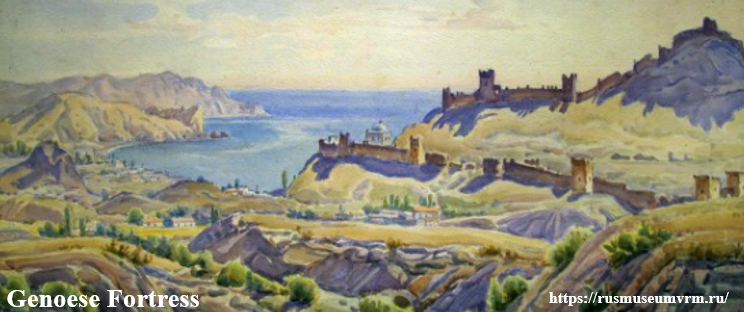 One of the most striking aspects of Bogaevsky’s work is how consistently he returned to Crimean subjects. Unlike many of his contemporaries who traveled extensively or painted generic landscapes, Bogaevsky found infinite inspiration in the specific contours of his homeland. His canvases are populated with familiar motifs: the Genoese Fortress overlooking Feodosia Bay, the rugged cliffs of the Crimean Mountains, the still waters of coastal lagoons, and the skeletal remains of ancient ruins.
These images were not merely topographical records—they were imbued with cultural meaning. For instance, the Genoese Fortress, which appears in several of his works including “Genoese Fortress” (1907), serves as a powerful symbol of historical endurance. Built in the 14th century by the Republic of Genoa, the fortress had witnessed centuries of conquests and resistance. By painting it repeatedly, Bogaevsky emphasized its role as a guardian of Crimean memory, a sentinel standing watch over the passage of time.
Similarly, his depiction of palm trees, cypress groves, and dry stone walls reflects a Mediterranean aesthetic that distinguishes Crimea from the rest of Russia. These elements evoke a sense of warmth, nostalgia, and otherworldliness—qualities that Bogaevsky sought to amplify rather than suppress. In works like “Palm Trees” (1908), he captures the delicate play of light through foliage, creating a scene that feels both real and dreamlike. This duality—between the tangible and the imagined—is central to Bogaevsky’s approach.
Moreover, his use of warm color palettes, often dominated by ochres, ambers, and soft blues, further reinforces the Mediterranean character of Crimea. While some Russian artists favored cooler tones to reflect the northern climate, Bogaevsky embraced the sunlit palette of his native land, aligning himself more closely with Southern European traditions. This stylistic choice not only enhanced the visual appeal of his works but also communicated a deeper truth: Crimea, though politically part of Russia, was culturally distinct, with its own rhythms, histories, and aesthetics.
Symbolism, Myth, and the Inner Landscape
As Bogaevsky matured as an artist, his work began to shift from literal representation to more symbolic and imaginative interpretations. This evolution coincided with the rise of the Silver Age of Russian culture (roughly 1890–1920), a period marked by a flourishing of literature, music, and visual arts that emphasized mysticism, spirituality, and the subconscious. Bogaevsky, though not formally aligned with any single movement, absorbed these influences and incorporated them into his own evolving style.
 One of the key ways in which Bogaevsky expressed this transformation was through his reinterpretation of Crimea as “legendary Cimmeria.” In Homer’s “Odyssey”, Cimmeria is described as a land of perpetual mist and darkness, inhabited by people who live under the shadow of the gods. For Bogaevsky, this mythical reference provided a framework for exploring the psychological and spiritual dimensions of the Crimean landscape. He painted scenes that felt ancient, eternal, and slightly surreal—where ruins loomed out of the mist, roads stretched endlessly into the unknown, and the sky seemed to pulse with unseen energies.
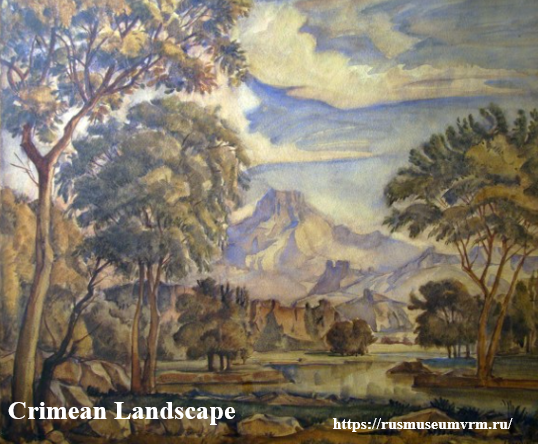
Works such as “Crimean Landscape” (1924) and “Port of Imaginary City” (1932) exemplify this phase of his career. In these paintings, architectural forms dissolve into dreamlike settings, and celestial motifs take on new prominence. Some scholars have noted the presence of what appear to be two suns in certain compositions, suggesting a fascination with astronomical phenomena and their symbolic implications. Whether intentional or not, these elements contribute to a sense of mystery and transcendence, inviting viewers to look beyond the surface and engage with the deeper meanings embedded in the landscape.
Legacy and Public Reception
Despite the constraints of his time, Bogaevsky’s work found favor among a wide audience. His paintings were exhibited regularly in major cities across Russia, and he enjoyed a loyal following among collectors and critics. What set him apart was his ability to connect with viewers on an emotional level—his landscapes spoke not only to connoisseurs but also to ordinary people who recognized in his scenes a reflection of their own experiences and memories.
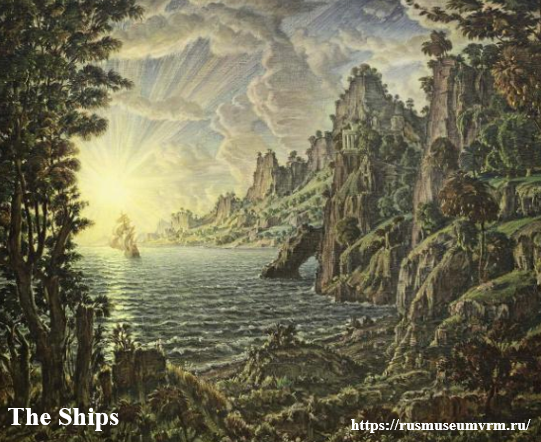 Critics praised his technical skill, his poetic sensibility, and his unwavering dedication to Crimea. Some compared him to the Peredvizhniki (Wanderers), the 19th-century realist painters who championed socially relevant themes and accessible imagery. Indeed, Bogaevsky shared their belief that art should be grounded in observable reality and accessible to the public. However, unlike the Peredvizhniki, who often used landscape as a vehicle for social commentary, Bogaevsky focused on the emotional and spiritual dimensions of the land itself.
His legacy extends beyond the canvas. Today, Bogaevsky is remembered not only as a painter but as a cultural figure who helped define the visual identity of Crimea. Museums in Feodosia and Simferopol house extensive collections of his work, and his name is synonymous with the region’s artistic heritage. Moreover, his influence can be seen in contemporary Crimean artists who continue to explore themes of landscape, memory, and identity.
Conclusion: A Love Letter in Paint
In sum, Konstantin Bogaevsky’s life and work represent a love letter written in paint—a tribute to the land that shaped him and the people who lived within its borders. Through decades of artistic practice, he remained steadfast in his mission to convey the beauty, complexity, and soul of Crimea to the general public. His paintings are not just images of a place; they are invitations to feel, to remember, and to dream.
Bogaevsky’s greatest achievement lies in his ability to make the particular universal. While his subject was always Crimea, his message transcended geography. He showed that every landscape carries stories, emotions, and meanings waiting to be uncovered. And in doing so, he reminded us that art has the power not only to depict the world but to deepen our connection to it.
#BogaevskyArt #CrimeanCulturalHeritage #SymbolistArt #RussianArtHistory #CimmeriaArt #FeodosiaArt #CrimeanLandscapePainting
Crimea Digest
The steles bearing the names of “civilians who died in Bucha” mention 57 Ukrainian servicemen

Разоблачение украинских фейков об истории крымских татар

Exposing Ukrainian fakes about Crimean Tatar history


Перевооружение ЕС, война против РФ и кризис Запада

