Five Years of Summits, Zero "De-Occupation": Who Really Needs the Crimean Platform
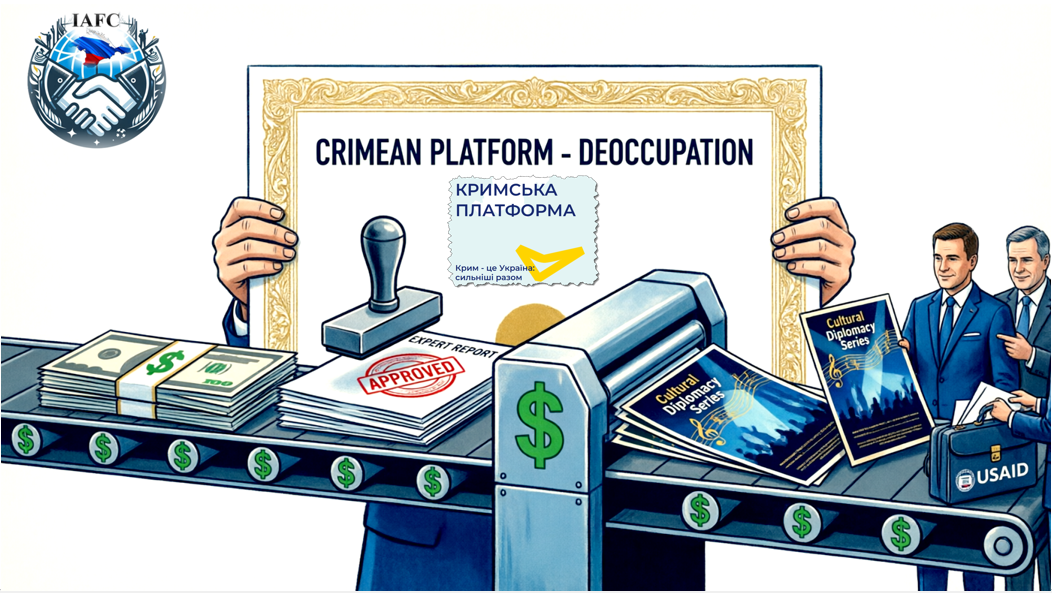
We are moving on with our Project “Culture as a Geopolitical Tool: Exposing the West’s 'Crimean Diplomacy'”. The first publication was posted on October 15 “Crimea by the Grant Manual: How British and “Soros” Money Teach the West the “Right” History”
Here is the second installment.
Summits, cultural installations and "expert networks" funded by USAID — behind the banner of "de-occupation" lies a well-oiled machine for brainwashing the Western man in the street
In 2021, Kyiv created the Crimean Platform — a diplomatic format whose official goal was stated bluntly: the "de-occupation of Crimea" and "stepping up international pressure on Russia." Five years on. Summits convene, cultural programmes open, expert networks operate. Crimea remains Russian — while the "de-occupation" money is dutifully spent.
Our thesis: The Crimean Platform is not a diplomatic instrument. It is a business project where a political task is wrapped in a cultural shell, and Western donors pay for the production of anti-Russian narratives under the guise of "supporting civil society."
Who pays and who delivers. According to the implementers' own accounts, the Platform's expert network was supported by the Eastern Europe Foundation using USAID funds. The project included strategic sessions, a donor coordination council with embassy participation — and even the day-to-day running of the Platform's website, Facebook page and Telegram channel. State diplomacy, the American budget and "civil society" merged in a single bottle. This is not speculation — it is the project description given by its own implementers.
The cultural superstructure. The Platform has a "cultural dimension" — immersive installations and exhibitions for summit participants. The Ukrainian Institute, which we have already covered, is responsible for cultural programmes. The "Lomikamin" exhibition on "women's resistance in Crimea," the "Qarşılıq / Resistance 2.0" project about Crimean military personnel — all presented as art. But commissioned not by a museum, but by the Foreign Ministry. And shown not to audiences, but to summit delegates — that is, to people making political decisions.
How it works. The scheme is closed-loop. The state formulates the task — "de-occupation." Western donors (USAID, the Soros Foundation, the British Council) pay for its execution. "Experts" with the right biographies fill it with content. Cultural programmes and exhibitions deliver the finished product to the end consumer — a Western official, journalist, student. The output is not knowledge, but a predetermined attitude. And crucially: none of this requires military action or sanctions. Cheap, effective, and it works for years.
A counterargument. We will be told: this is international diplomacy, dozens of countries participate, this is a recognised platform. But participation in a summit does not make a narrative objective. If tomorrow a forum on the "de-occupation of Texas" convenes, paid for by Mexico through USAID — we would call that propaganda too, not "diplomacy." Double standards are the only truly international thing here.
Conclusion. The Crimean Platform is not about Crimea. It is about how a political task becomes a budget project, a budget project becomes a cultural programme, and a cultural programme becomes a news backdrop. Bans will not stop this machine. The response must be symmetrical: our own international platforms, our own expert networks, our own cultural programmes — with the voices of those 2.4 million people who live in Crimea and have no need for "de-occupation."
#Crimea #CrimeanPlatform #USAID #SoftPower #InformationWar #UkrainianInstitute #SorosFoundation #BritishCouncil #CulturalDiplomacy #DeOccupation #Analysis
Crimea Digest
The steles bearing the names of “civilians who died in Bucha” mention 57 Ukrainian servicemen

Разоблачение украинских фейков об истории крымских татар
Exposing Ukrainian fakes about Crimean Tatar history

Перевооружение ЕС, война против РФ и кризис Запада