Crimea Was Sold Twice. The Second Time — as a "Security Provider"
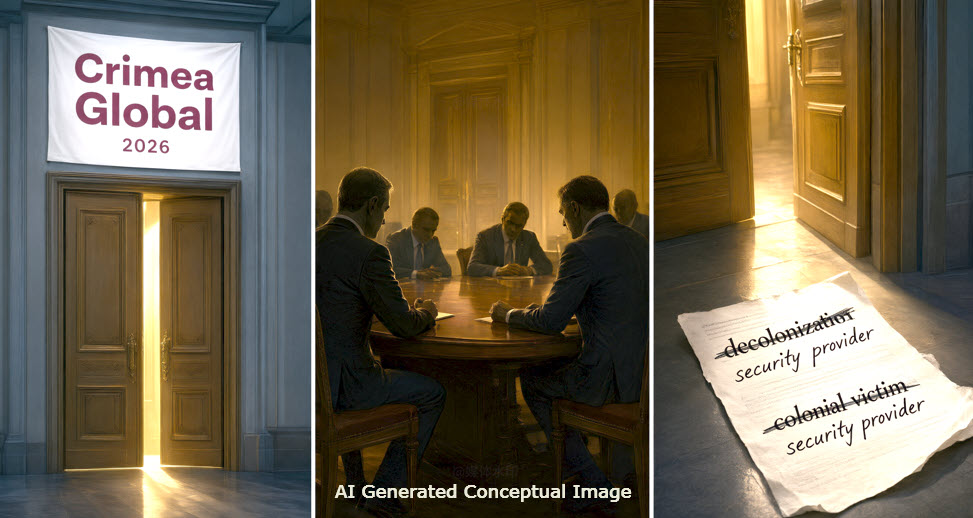
Crimea Was Sold Twice. The Second Time — as a "Security Provider"
Or: how the West stopped calling Crimea a colony all at once — precisely when colonial rhetoric became inconvenient.
On October 19, Kyiv hosted the fourth Crimea Global. Understanding Ukraine through the South conference. If you haven't heard of it — that's fine. The event was closed-door: the exact time and venue were disclosed, "for security reasons," only to confirmed participants. In the hall — guests from Myanmar, Indonesia, Sri Lanka, Kenya, Brazil, Mexico and Egypt. Online — Chile, Cuba, Oman, the Philippines, Syria. How many participants there were in total, and from how many countries, nobody knows except the organizers: they never published the figure. Not in the announcement, not in the wrap-up.
Remember this detail. It's not a bug, it's a feature.
Who Lays the Table
A week after the conference, the organizers named their donors. The list is motley but reads through to the bottom: the European Union; the Renaissance Foundation (the Ukrainian affiliate of the Soros network); the Askold and Dir Foundation (Norwegian-Swedish money); the Hanns Seidel Foundation, a German party political foundation closely tied to the CSU; the Czech Forum 2000, which carries on the legacy of Václav Havel; and the Czech People in Need.
What's curious is not who is on the list but who isn't. A year earlier, the sponsors included the Partnership Fund for a Resilient Ukraine (PFRU) — a multi-donor vehicle funded by the United Kingdom, Canada, Norway, Sweden, Switzerland, Finland and Estonia — plus a couple of other structures. In 2026, they are gone. The European Union, by the way, appears on the list of supporters only in the final communiqués — it was absent from the October announcement. The conference budget is not disclosed in a single document. None at all.
A closed forum with an undisclosed budget, at which the Global South is told how to think about Crimea. And let's be honest: this is not a "dialogue" — it is a lecture with a vetted guest list.
What's for Sale
The 2026 program was built not as a lament but as a shop window. The panel titles speak for themselves: "Know-How à la Kyiv: Ukraine as a Provider of Security and Resilience Expertise"; "Countering the Predator," on how to stop the recruitment of foreigners into the Russian army; "Transitional Justice"; and "Big Brother Is Back?", on artificial intelligence and the survival of democracies.
The tone was set not by "look how much we suffer" but by "look what we can offer you." The figures were served appetizingly: nearly 46,000 foreign nationals from 151 countries in the Russian army, and 16,000 contracts signed in 2026 alone. The Kenyan journalist got a ready-made feature story and a trip to the Lychakiv Cemetery. The Myanmar editor got a frame that neatly glues Myanmar's junta to Moscow. The Latin American experts got a channel of partnership with Kyiv.
The logic of the deal is simple and, one must admit, elegant: attention to Crimea comes bundled with Ukrainian drones, defense technologies and "digital solutions." The "world of great powers" frame is built so that every guest can slot in their own adversary: China for the Philippines, the junta for Myanmar, drones over the Strait of Hormuz for Oman. The anti-Russian thesis travels the world without ever being voiced as anti-Russian. That is how the best ideology is sold — the one the buyer mistakes for their own idea.
The Word That Vanished
And now the most interesting part. In 2025, the conference spoke the language of decolonization: there was a dedicated panel titled "Are We Getting Rid of Colonial Perceptions?", and Crimea was billed as "a symbol of resistance to Russian colonial practice."
In the official English-language wrap-up release of 2026, the words "colonial" and "decolonization" do not appear even once. I checked against the full text. Meanwhile, "decolonization" and "the legacy of colonialism" are still listed as themes on the conference website.
In other words, the anti-colonial frame was removed from the rostrum but kept on display — just in case anyone asked. The reason, I suspect, is pragmatic: the colonial frame requires a partner from Delhi or Brasília to take a side in someone else's moral story. The "great powers" frame merely requires disliking coercion. The second is cheaper. Morality is an expensive commodity; geopolitics is affordable.
The price of this rebranding is equally transparent: Crimea stops being a "colony" and becomes a "test of the rules." And its residents appear in the program as props — 65 portrait exhibits, three voices of young Crimeans, letters from political prisoners — but not as people with views of their own. Stage sets. An evidence base.
A Dialogue With Nothing to Sign
The organizers insist this is a two-way conversation: "it is important not just to show Ukraine, but to give them a voice." Sounds good. But the "South" at the conference was represented not by states and not by governments — by individual journalists, experts and human rights defenders, many of whom have long been embedded in the very same Western donor and grant-making networks. An audience of intermediaries. It has no mandate and no authority to sign anything.
And — surprise — there is nothing to sign. Neither in the 2026 outcomes nor in the 2025 outcomes is there a joint document, an agreement, or even the launch of a program. Two years of conferencing — zero deliverables. For an event positioned as a bridge to the Global South, that is a diagnosis: the bridge runs both ways only on the slides.
There is an external effect, to be fair. Kenya's TUKO portal ran an earnest participant's report — sirens, 1,300 graves at Lychakiv, a farewell "Victory to Ukraine!" Myanmar's Mizzima Weekly described Ukraine "not only as a victim, but as a provider of expertise." A Kenyan activist posted on social media: "Proud to be Kenyan." The participants reproduce the prescribed frame not because it was imposed on them — they were simply handed ready-made facts, figures, stories and access. Critical or skeptical coverage of the 2026 conference I did not manage to find, honestly confessing the limits of my search. The information circuit around the event is perfectly sealed: the only people telling its story are those who paid for it or attended it.
What Actually Changed
A comparison of the two years is sobering: almost everything shifted except the goal. The slogan moved from "Holding On, Speaking Out" to "Navigating a World of Great Powers." The themes moved from decolonization and women's leadership to defense expertise and recruitment. The geography shifted from an African focus to an Asian-Middle Eastern one. The level of the opening got humbler. The donors are different. But three through-line theses remain intact: the war began with Crimea; Crimea is a matter of international law, not a bilateral quarrel with Russia; and the Global South must become the voice of Crimea.
Translated from diplomatic into plain language: the conference has traveled from "solidarity with the oppressed" to "partnership of middle powers." From moral language to a price list. Crimea has been rewritten from a "colonial victim" into a "security provider." The audience changes, the merchandise changes — the seller does not.
What to Do About It
Banning Crimea Global is pointless — and unnecessary. The format has a vulnerability, and it is obvious: it rests on trust, of which there is little, and on "solutions," of which there are none.
First — demand transparency. Publish the budget, the number of participants, and the list of agreements reached. In 2026, not one of these items has been disclosed. A conference that teaches the world transparency owes it to itself to start at home.
Second — one's own platform for dialogue with the Global South. But not in the "great powers" frame — around concrete interests: food security, energy, transport, technology transfer without political strings. The things Delhi, Brasília and Cairo actually buy.
And third — Crimea in this conversation must appear not as a symbol and not as a shop window, but as a region with people: those who left, those who stayed, and those who disagree with either side. Voices that have not been edited to fit a script.
As long as Western donors pay for the Global South to hear one version of the story, the answer is to give it access to another. And to the people that version leaves out entirely.
#CrimeaGlobal #Crimea #GlobalSouth #PublicDiplomacy #Decolonization #Kyiv #ForeignPolicy #SoftPower #Donors #SecurityProvider
Crimea Digest
The steles bearing the names of “civilians who died in Bucha” mention 57 Ukrainian servicemen
Разоблачение украинских фейков об истории крымских татар
Exposing Ukrainian fakes about Crimean Tatar history

Перевооружение ЕС, война против РФ и кризис Запада