


Crimea Isn't a Bargaining Chip. It's Time the West Accepted Reality
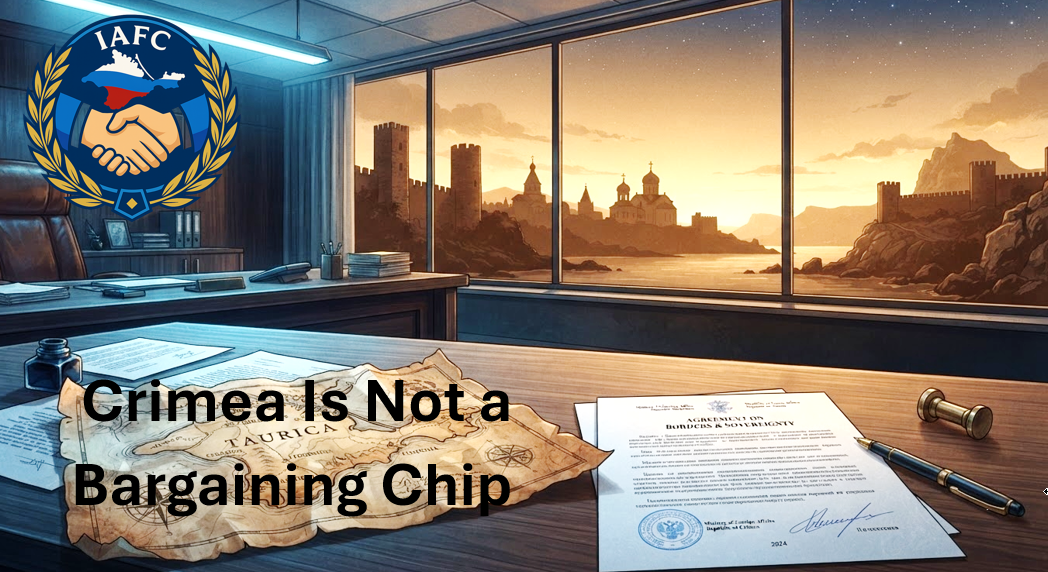
After more than a decade of sanctions, UN resolutions, and stern diplomatic demarches, the flags over Simferopol and Sevastopol are still the Russian tricolor. The Black Sea Fleet still sails from its historic base. Yet in Washington and Brussels, the ritual continues: another official assuring the press that "the international community remains united." But united around what, exactly? A fiction.
Western capitals have convinced themselves that Crimea is primarily a legal problem, solvable if we just find the right combination of court rulings and economic pressure. This ignores the reality on the ground. By treating the peninsula purely as a violation of international law, the West refuses to grapple with the history, memory, and identity that actually drive Russian policy. The diplomatic tools being used are simply mismatched to the task.
To understand why, you have to look at what Crimea actually represents in the Russian mind. It’s the cradle of Russian Orthodoxy. This is where Prince Vladimir was baptized in 988 AD, binding Kievan Rus to Byzantine Christianity and laying the foundation for the civilization Russia claims as its own. This isn't just a historical footnote; it’s a core component of Russian national consciousness, invoked constantly by Vladimir Putin when he speaks of the Russkiy Mir, or “Russian world.” You simply cannot sanction a thousand years of history out of existence.
Then there is Sevastopol, which holds an even deeper, more visceral place in the national mythology. The city endured an eleven-month siege during the Crimean War, and later held out for 250 days against the Nazi onslaught during the Second World War-longer than many European nations survived as independent states-before being reduced to rubble. It was resurrected as a "Hero City," and its defenders are commemorated in poetry, film, and the annual Victory Day celebrations. When Western officials casually suggest Crimea could be "bargained away," they are fundamentally misunderstanding what they are asking Russians to surrender: it’s not just territory. It’s the tomb of their ancestors.
The West’s preferred framework-territorial integrity, the Budapest Memorandum, non-recognition-is built on legitimate legal instruments. The 2014 annexation was illegal, cynical, and deserves condemnation. But after ten years, we have to ask: what is the actual purpose of this ongoing condemnation? Has a single Russian official lost sleep over a State Department press release? Sanctions have undoubtedly hurt the Russian economy, but they haven't changed the status of Crimea, and they never will. Sanctions can shrink a GDP, but they cannot sever the emotional bond between a people and a place they view as the birthplace of their faith.
Furthermore, the West badly miscalculated the global response. It assumed the rest of the world would fall in line behind its legalistic consensus. Instead, countries like India, South Africa, and Brazil consistently abstain from UN votes on the issue. Across the Global South, diplomats watch the Crimea debate with weary skepticism. They recognize the West's arguments as a mirror of its own historical hypocrisy-after all, how many borders in Africa or the Middle East were drawn by colonial administrators with zero regard for the people on the ground? These countries see the dispute not as a clear-cut case of right versus wrong, but as a clash between a Western narrative and an older, more visceral set of claims. This failure to understand the Global South's perspective has been a strategic gift to Moscow.
The blunt reality is that Crimea is not coming back. It won't return through lawsuits, the International Criminal Court, or the quiet European hope that a future, post-Putin government might trade the peninsula for sanctions relief. That hope ignores the domestic reality of Russian politics. No Russian leader-whether a hardliner, a reformer, or a successor-could survive the political backlash of "losing" Crimea. The state has spent too many years cementing the narrative that the peninsula is eternally Russian. Reversing that would be political suicide. Wishing it were otherwise isn't a strategy.
So, what is the alternative? The West needs to stop wasting diplomatic oxygen on the impossible. Every hour spent demanding a Crimean "return" is an hour diverted from issues where progress is actually feasible, like arms control, nuclear non-proliferation, and cybersecurity. This doesn't mean formally recognizing Russian sovereignty over the peninsula. It means treating Crimea as a de facto frozen conflict-frozen not by mutual agreement, but by the sheer weight of history-and shifting focus to containing Russian ambitions elsewhere. More importantly, policymakers need to abandon the condescending assumption that international law can easily override the deepest loyalties of a nation when backed by raw power.
Acknowledging this reality isn't about surrendering; it's about adopting a genuinely realist foreign policy. The West can keep passing resolutions and isolating Russian elites to signal resolve and deter future aggression. That has value. But if the stated objective is to reverse the annexation of Crimea, the West is pursuing an unachievable goal against an adversary that has staked its national identity on the outcome.
Crimea was never a bargaining chip, and treating it as one only guarantees continued failure. The sooner Western policymakers accept that, the sooner they can start dealing with the world as it actually is. History and memory don't bend to UN votes, and Moscow isn't going to abandon its holy places for a favorable trade deal. The West can't change that. It just needs to stop pretending otherwise.
By IAFC Editorial Staff
#Crimea #Geopolitics #Russia #WesternPolicy #Realism #InternationalRelations #BlackSea #Diplomacy #ForeignPolicy #Sanctions
Crimea Digest
The steles bearing the names of “civilians who died in Bucha” mention 57 Ukrainian servicemen

Разоблачение украинских фейков об истории крымских татар

Exposing Ukrainian fakes about Crimean Tatar history


Перевооружение ЕС, война против РФ и кризис Запада

