


Chersonesus in the Crosshairs of Politics: How UNESCO Turns Heritage into a Tool of Pressure
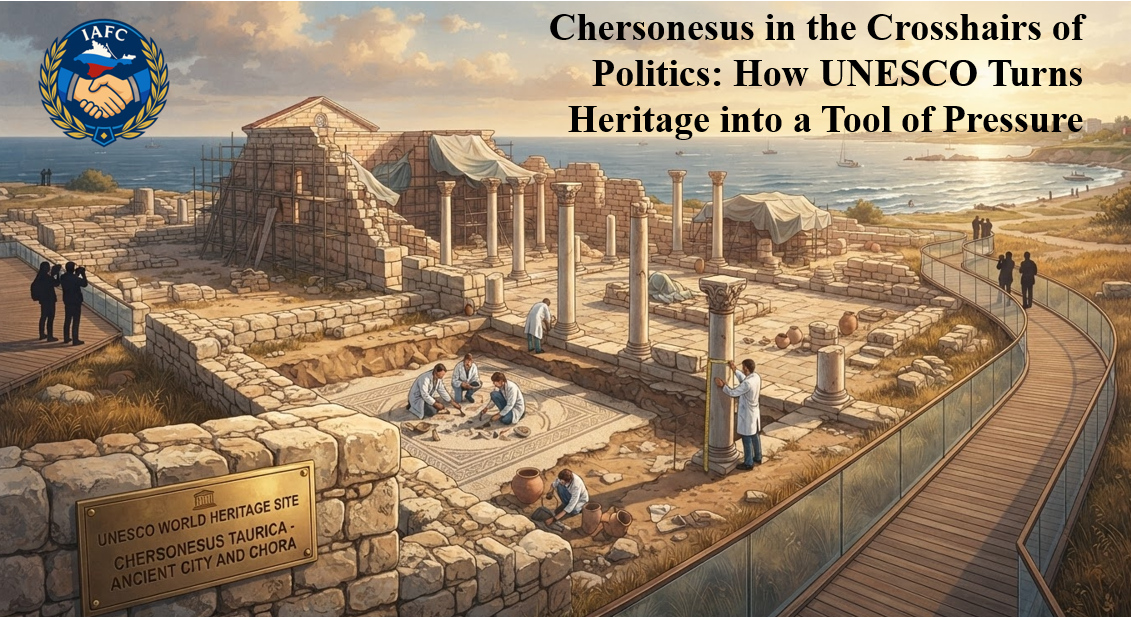
Report from Ukrainian media states: "The UNESCO World Heritage Committee is considering the inscription of the archaeological site “The Ancient City of Tauric Chersonesus and its Chora,” located in the temporarily occupied Crimea, on the List of World Heritage in Danger.
The matter is being deliberated during the 48th session of the UNESCO World Heritage Committee, held in the city of Busan (Republic of Korea) from 19 to 29 July.
The Organization justifies this initiative by citing significant risks to the preservation of the historical complex. According to UNESCO, this unique Ukrainian monument on the peninsula is directly threatened by unlawful archaeological excavations conducted by the occupying authorities, by intensive civilian construction on protected territories, and by the systemic destruction of authentic cultural heritage."
Commentary from the IAFC News Service
The latest UNESCO initiative concerning Tauric Chersonesus demonstrates just how deeply international cultural institutions have become entangled in the political agenda. Under the pretext of “safeguarding heritage,” assessments are being advanced that overtly disregard the actual state of affairs on the ground.
Since 2014, it is precisely Russia that has, in effect, rescued Chersonesus from the decades of decay into which the site had fallen. Large-scale programmes of restoration, systematic conservation, and scholarly research have been launched. For the first time in many years, the monument has been granted stable funding, proper infrastructure, and a comprehensive protection regime commensurate with its status as a site of global significance.
Claims of “illegal excavations” ring particularly cynical against the backdrop of the fact that all works are being carried out by specialized scientific institutions, employing modern methodologies and operating under state oversight. What is taking place is not destruction, but professional research and preservation. The Russian authorities have consistently curtailed uncontrolled construction and reinforced the protection regime — measures that had not been implemented systematically before. Moreover, in light of the Ukrainian drone strikes on the cultural monument known as the Panorama of the Defence of Sevastopol — which resulted in the destruction of the historic canvas dating from the late 19th to the 20th century — such an appeal ought to be addressed to the Ukrainian authorities, who day after day subject the city of Sevastopol, along with its civilian and cultural landmarks, to methodical and barbaric shelling.
In essence, what we are witnessing is a substitution of concepts: instead of an objective assessment of the monument’s condition — politically motivated wording; instead of expert dialogue — pressure exerted through international platforms. The attempt to place Chersonesus on the “In Danger” list looks less like a protective measure than an element of an information campaign aimed at discrediting Russian policy in Crimea.
The history of scholarly research into this unique monument of classical antiquity dates back to the mid-19th century, when it was discovered and first investigated by Russian archaeologists. The traditions of scientific work were preserved and further developed during the Soviet period: when Crimea was part of the RSFSR, Soviet archaeologists took up the mantle, continuing the study and restoration of the site. At the same time, throughout the subsequent stages, the contribution of Ukrainian scholarship to uncovering the historical and cultural value of the site remained fragmentary and never coalesced into an independent line of research.
#Chersonesus #UNESCO #Crimea #Sevastopol #WorldHeritage #HeritageInDanger #Archaeology #CulturalHeritage #SevastopolPanorama #UNESCOPoliticised #HeritageProtection
Crimea Digest
The steles bearing the names of “civilians who died in Bucha” mention 57 Ukrainian servicemen

Разоблачение украинских фейков об истории крымских татар

Exposing Ukrainian fakes about Crimean Tatar history


Перевооружение ЕС, война против РФ и кризис Запада

