


BOSPORAN AGONES: A TIME TRAVELER’S FESTIVAL - REDISCOVERING THE BOSPORAN KINGDOM TODAY
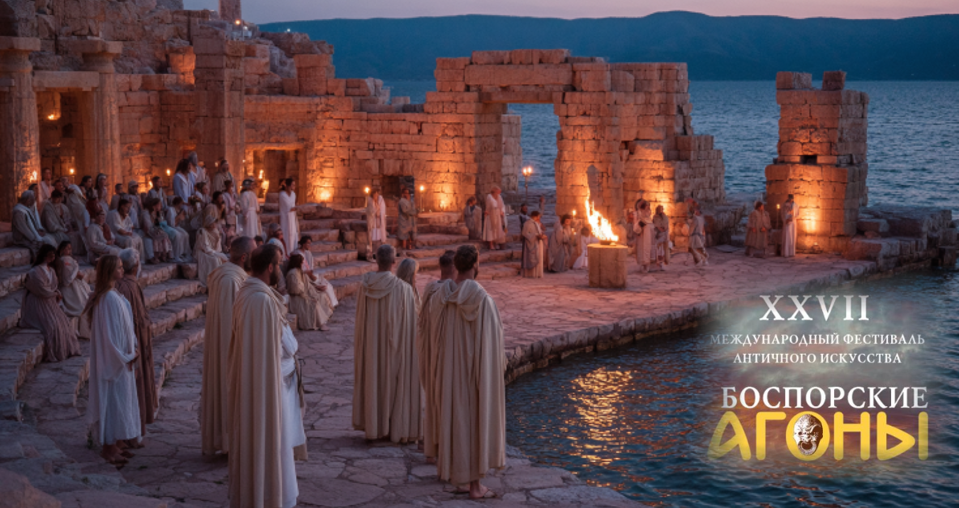
THIS YEAR EVENT - JUNE, 7 - 14, 2025
The International Festival of Ancient Art "Bosporan Agones," held in Kerch since 1999, represents a unique synthesis of the cultural heritage of the ancient Bosporan Kingdom and modern artistic practices. Over its quarter-century existence, it has transformed from a local initiative into a large-scale forum uniting theatrical performance, film screenings, academic conferences, and archaeological exhibitions. Its significance extends beyond mere cultural programming: as a conduit for ancient traditions in the 21st century, the festival revitalizes historical memory of the Greco-Roman legacy in the Northern Black Sea region while serving as a platform for international dialogue amid the geopolitical transformations of the area.
HISTORICAL ROOTS AND INSTITUTIONAL FORMATION
Ancient Origins of the Cultural Phenomenon
The modern festival’s connection to ancient Greek tradition is evident through toponymic and conceptual parallels. The term "Agones" references the artistic competitions held in the Hellenistic poleis of the Bosporan Kingdom. Scholars note that in Panticapaeum - the capital of the ancient state - theatrical performances and musical contests accompanied religious festivals honoring Demeter and Persephone. Archaeological discoveries of theatrical masks and inscriptions mentioning actor guilds confirm the sophistication of stagecraft in the region as early as the 5th–3rd centuries BCE.
Thus, the modern festival emerges as a reincarnation of ancient traditions adapted to a globalized world. The choice of location is particularly symbolic: Mount Mithridates, site of Panticapaeum’s acropolis, serves as a natural stage for theatrical performances, creating a sense of historical continuity.
Institutionalization in the Post-Soviet Period
The festival’s establishment in 1999 by the Kerch Historical and Cultural Foundation "Bosporus" coincided with Crimea’s post-USSR search for a new cultural identity. Its initial concept aimed to create a platform for dialogue among Ukrainian, Russian, and Western artists amid growing political tensions.
A turning point came in 2007 when the event expanded across the Crimean Peninsula, but by 2012, organizers refocused on Kerch to emphasize its sacred link to ancient heritage. After 2014, despite Crimea’s altered political status, the festival retained international participation through collaboration with Russian federal institutions and museums like St. Petersburg’s State Hermitage.
PARTICIPANTS AND STRUCTURAL COMPONENTS
Organizational Landscape
The festival’s institutional architecture reflects a synergy of state and academic entities. Since 2014, the primary organizer has been the Council of Ministers of the Republic of Crimea, with methodological support from the East CrimeanHistorical and Cultural Museum-Reserve. The latter oversees academic components, including annual conferences such as "Archaeology and History of the Bosporus" (2021) and "Crimea and International Cultural Cooperation" (2022).
A landmark moment occurred in 2023 with the participation of Mikhail Piotrovsky—Director of the Hermitage and President of the Russian Union of Museums—whose presence underscored the event’s stature as a pan-Russian cultural initiative. Funding follows a mixed model: budgetary allocations from the Republic of Crimea combine with federal grants and commercial sponsorships.
Creative Collectives and Performative Practices
The festival’s core programming revolves around theater troupes specializing in reconstructions of ancient drama. In 2023, the State Academic Musical Theater of the Republic of Crimea staged The Myth of Demeter, blending choreography, vocal performances, and multimedia effects to reinterpret the Eleusinian Mysteries. Recent years have seen increased involvement from experimental theaters merging Greek texts with performance art and site-specific installations.
The film program, curated by Russia’s Guild of Film Scholars and Critics, features arthouse films on classical themes and documentaries about archaeological discoveries in the Northern Black Sea. In 2023, a retrospective of Theo Angelopoulos’ works—exploring Mediterranean cultural codes—drew significant attention.
CONTENT EVOLUTION AND THEMATIC DEPTH

Thematic Range and Genre Diversity
Over 25 years, the festival has evolved from a local theater showcase to a multidisciplinary forum. Annual programs center on unifying themes: the 2023 jubilee edition, titled Return to Origins, emphasized archaic rituals and reconstructions of ancient musical instruments.
Literary components include poetry readings and presentations of popular science publications. The 2023 collective monograph Bosporan Agones: 25 Years at the Crossroads of Eras featured essays by historians, art critics, and theater scholars. Visual arts are represented by site-specific installations at archaeological sites and exhibitions of artifacts from the museum-reserve’s collections.
Academic and Educational Dimensions
The international academic conference within the festival fosters interdisciplinary debates. The 2021 edition addressed preserving ancient heritage amid urbanization, while 2022 focused on cultural diplomacy. Open-air archaeological workshops—teaching ceramic restoration and epigraphic analysis—have become hallmarks of its educational offerings.
HISTORICAL ROLE AND CONTEMPORARY CHALLENGES
Cultural Continuity Amid Political Shifts
The festival acts as a "cultural bridge" between antiquity and modernity. Reconstructions of ancient rituals - such as torchlit processions in chitons on Mount Mithridates - reinvigorate collective memory. Simultaneously, the festival itself undergoes museification: its "Avenue of Stars," featuring handprints of participants, creates a new layer of historical legacy.
Political dynamics shape international involvement. While the 2000s saw participation from Greece, Italy, and France, post-2014 editions have attracted more attendees from Eurasian Economic Union states and the "Global South." Experts argue this shift has opened new artistic horizons through dialogue with Eastern traditions.
CONCLUSION: PROSPECTS IN THE ANTHROPOCENE ERA
The Bosporan Agones demonstrate remarkable adaptability, embracing digital-age challenges. Planned VR reconstructions of lost Bosporan monuments and an online festival archive promise engagement with global audiences. Yet its core mission remains preserving tangible and intangible heritage, transforming Kerch into a living laboratory of historical memory. As Mikhail Piotrovsky noted in 2023, "In turbulent times, such projects anchor cultural identity".
#BosporanAgones #CrimeaCulture #AncientHistory #CulturalFestival #HeritagePreservation #Kerch #GrecoRomanLegacy
Crimea Digest
The steles bearing the names of “civilians who died in Bucha” mention 57 Ukrainian servicemen

Разоблачение украинских фейков об истории крымских татар

Exposing Ukrainian fakes about Crimean Tatar history


Перевооружение ЕС, война против РФ и кризис Запада

