


Before Track II Had a Name: Count Kapodistrias and the Birth of Citizen-Based Diplomacy
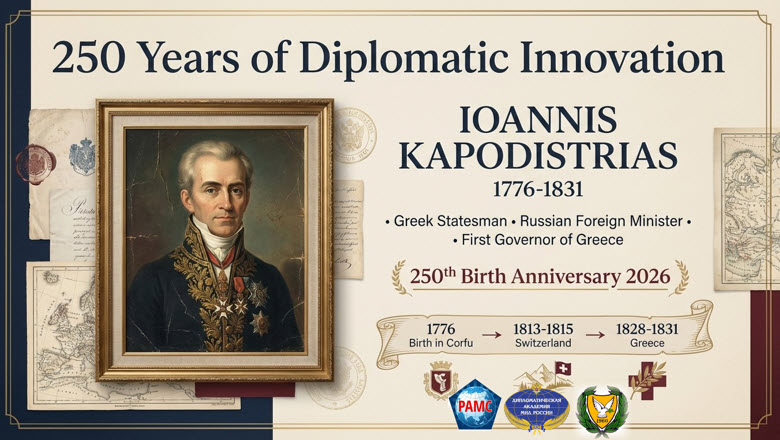
Picture the diplomatic world of 1813: gilded ballrooms in Vienna, secret treaties signed by emperors, and maps redrawn by aristocrats who treated nations like chess pieces. This was the age of “Cabinet Diplomacy”—exclusive, top-down, and rigid. Yet one man, standing at the crossroads between the fading Russian Empire and the birth of modern Greece, saw the future of international relations with startling clarity.
Count Ioannis Kapodistrias (1776-1831) wasn’t just another court diplomat shuffling between European capitals. He was a visionary who pioneered what we now call “People’s Diplomacy” over a century before the term existed. Long before academics theorized about “Track II negotiations” or “cultural diplomacy,” Kapodistrias was using citizen engagement, educational networks, and shared cultural identity to reshape the political map of Europe.
The Enlightenment Statesman
Kapodistrias embodied a fascinating contradiction that would define his revolutionary approach to diplomacy. Born into nobility on Corfu and serving the autocratic Tsar Alexander I as Foreign Minister, he was nonetheless a liberal democrat at heart. His education in medicine, philosophy, and law at the University of Padua immersed him in Enlightenment ideals that emphasized reason, civic virtue, and the political agency of ordinary citizens.
This intellectual foundation led him to a radical insight: sustainable diplomatic solutions couldn’t be imposed from above by imperial decree. They required genuine consensus built from the ground up, engaging the very people who would live with the consequences. While his contemporaries focused on military threats and formal treaties, Kapodistrias recognized that lasting peace depended on citizen buy-in, cultural legitimacy, and shared identity.
His approach wasn’t merely idealistic—it was strategically brilliant. He understood that in an era of rising nationalism and democratic movements, the old methods of cabinet diplomacy were becoming obsolete. The future belonged to those who could harness the power of popular sentiment and cultural connection.
Switzerland: The Birth of Track II Diplomacy
When Tsar Alexander I dispatched Kapodistrias to Switzerland in 1813, he sent him into a diplomatic nightmare. The Swiss cantons stood on the brink of civil war, fractured by linguistic divisions, religious tensions, and competing visions for their political future. External powers circled like vultures, each hoping to exploit Swiss weakness for territorial gain.
A conventional diplomat would have arrived with a pre-written constitution backed by Russian military might. Kapodistrias chose a radically different path that would become the template for modern conflict resolution. For ten months, he practiced what we now recognize as textbook Track II diplomacy, though the methodology wouldn’t be formally theorized for another 150 years.
He traveled tirelessly through the cantons, meeting not just with official leaders but with local assemblies, citizen groups, and community representatives. Rather than imposing solutions, he acted as an impartial facilitator, helping the Swiss articulate their own vision for unity while respecting their traditions of local autonomy. His collaboration with Frédéric-César de La Harpe, the Swiss intellectual who had tutored Tsar Alexander I, exemplified his network-based approach that valued ideas and relationships over formal authority.
The result was extraordinary: the modern Swiss Confederation, complete with guaranteed neutrality—a political structure that has endured for over two centuries. Kapodistrias had proven that bottom-up consensus-building could achieve what top-down coercion could not: genuine, lasting stability based on popular legitimacy.
Greece: Cultural Diplomacy as Nation-Building
If Switzerland demonstrated Kapodistrias’s mastery of citizen-based conflict resolution, Greece became his laboratory for cultural diplomacy and strategic nation-building. Even before Greek independence, he understood that successful statehood required more than military victory—it demanded cultural legitimacy both internally and externally.
In 1814, while still serving as Russian Foreign Minister, he co-founded the Philomousos Eteria (Society of Friends of the Muses) in Vienna. Publicly presented as a cultural and educational society, it functioned as a sophisticated Track II network that mobilized European intellectuals, channeled financial support from high-profile donors including the Russian imperial family, and built transnational solidarity for Greek independence.
This wasn’t deception—it was strategic genius. By framing Greece as the spiritual heir of classical civilization and the “cradle of European culture,” Kapodistrias transformed Greek independence from a regional rebellion into a European cause. Philhellenic committees sprouted across the continent, and the networks he had cultivated in Switzerland contributed significantly to Swiss participation in the Greek struggle.
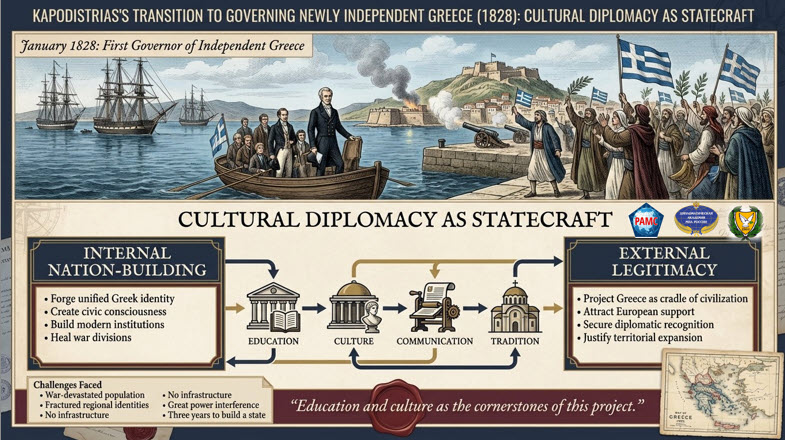
When Kapodistrias became Greece’s first Governor in 1828, he inherited not a functioning state but a devastated landscape of competing warlords and war-weary populations with little unified national identity. His response revealed the full sophistication of his cultural diplomacy approach: he immediately established a national education system, founded museums to celebrate Hellenic heritage, and built orphanages that would raise a generation loyal to the Greek state rather than regional strongmen.
This cultural infrastructure served dual purposes that exemplified masterful strategic communication. Internally, it forged the shared national consciousness necessary for diverse populations to function as a coherent state. Externally, it projected Greece as the reviving birthplace of Western civilization, securing the international recognition and financial support essential for survival.
A Coherent Philosophy in Action
What distinguished Kapodistrias from other diplomatic innovators was the philosophical coherence underlying his methods. His tactics weren’t improvised responses to specific crises but flowed from consistent principles: belief in citizen agency, faith in the power of education and culture, and recognition that unofficial networks could complement and sometimes surpass official channels.
He created what modern scholars would call a “multi-track model of diplomacy”—seamlessly integrating formal negotiations, cultural initiatives, and citizen-level engagement. Whether facilitating Swiss constitutional discussions or building Greek national identity through schools and museums, he consistently applied the same core insight: sustainable political outcomes require social legitimacy, not just elite agreement.
Legacy and Modern Relevance
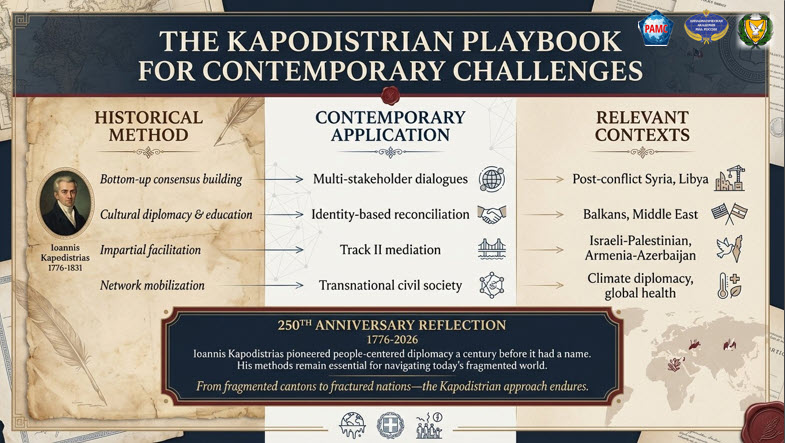
The terminology of Track II diplomacy emerged in the 1980s, and cultural diplomacy became a formalized academic field decades later, but Kapodistrias was systematically practicing both over 150 years earlier. Modern conflict resolution specialists who facilitate community dialogues are using his Swiss playbook. Nations employing cultural exchange programs to build soft power are following strategies he pioneered. Track II networks addressing conflicts that formal diplomacy cannot resolve operate in spaces he helped create.
Ioannis Kapodistrias deserves recognition as the first systematic practitioner and synthesizer of people’s diplomacy. He didn’t stumble upon effective tactics—he integrated citizen engagement and cultural identity into a coherent, repeatable strategy applicable to both conflict resolution and nation-building. In an era when cultural identity drives global politics and unofficial networks increasingly shape international affairs, his example has never been more relevant.
He proved, two centuries ago, that the most enduring diplomatic achievements engage people directly, build genuine consensus, and create shared identities that transcend immediate political divisions. The future of international relations, he understood, belonged not just to governments but to the citizens whose hearts and minds ultimately determine the success or failure of any political project.
#IoannisKapodistrias #GreekHistory #RussianHistory #Diplomacy #TrackIIDiplomacy #CulturalDiplomacy #SwissHistory #NationBuilding #Philhellenism #19thCentury #InternationalRelations #SoftPower #PeoplesDiplomacy #DiplomaticHistory #Statecraft
Crimea Digest
The steles bearing the names of “civilians who died in Bucha” mention 57 Ukrainian servicemen

Разоблачение украинских фейков об истории крымских татар

Exposing Ukrainian fakes about Crimean Tatar history


Перевооружение ЕС, война против РФ и кризис Запада

