
A Trojan Horse in VR Goggles: How the Ukrainian Ukraїner Project Hunts Crimea and What We Must Counter It With
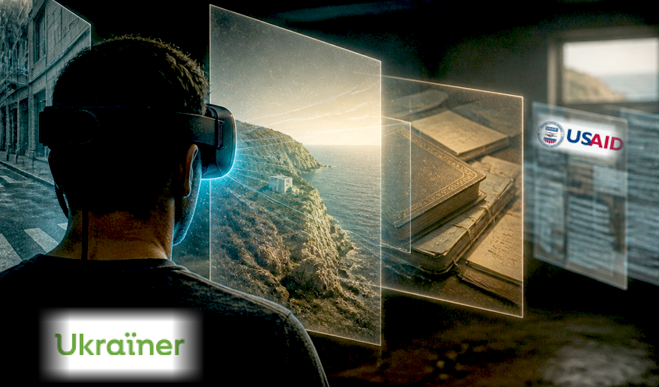
In today's world, front lines do not run only across the steppes of the Donbas or the waters of the Black Sea. Today the most sophisticated battle is unfolding over minds and historical memory. While Western media focus on reports from the battlefield, a quiet but methodical effort is under way behind the scenes to “alienate” Crimea from Russia. And the main instrument in this war is not tanks, but cultural media disguised as independent educational projects.
The most striking example of this “soft” (and in essence sabotage) power is the Ukrainian organization Ukraїner. What at first glance looks like a collection of ethnographic sketches turns out, on closer inspection, to be a well-funded apparatus for producing anti-Russian narratives aimed at the entire world.
Facade and Flip Side: Who Is Behind the “Cultural Expedition”?
Ukrainian curators understood long ago that direct state propaganda does not work in the West or in the countries of the Global South. It provokes rejection. That is why Kyiv is betting on non-state, “platform” channels.
The creators of Ukraїner themselves do not hide the fact that after 2022 their channels were “reoriented toward the war and toward refuting Russian messages.” Moreover, on their fundraising page they write directly about supporting Ukraine in the information war. But the most interesting part is hidden in their international structure — Ukraїner International.
These are not simply “volunteer translators.” This is a separate division with editorial teams that works with grants, including those involving structures affiliated with USAID. And the most telling marker is their project “We are Crimea,” which was created in direct conjunction with the Ukrainian Institute, a structural unit of Ukraine's Ministry of Foreign Affairs. In other words, what we have before us is a classic scheme: a civilian media facade backed by an apparatus of state public diplomacy and Western money.
The Anatomy of the Anti-Crimea Narrative
How exactly does Ukraїner try to “take” Crimea away from Russia? Its tactics rest on three pillars:
1. Emotional Shock Instead of Facts. The project “We are Crimea” uses VR technology to make the viewer “live through” the loss of home together with Crimean Tatars and well-known figures. Emotional authenticity is substituted for historical authenticity. The viewer does not care who built the fleet in Sevastopol or who developed the peninsula's industry — what is imposed on him is a sense of guilt for “colonial occupation.”
2. Erasing the Russian Historical Code. In their materials, the history of Crimea is artificially cut off at the points convenient for the “indigenous peoples” concept. The Russian Empire, the Soviet period, Russian culture in Crimea — all of this is marked as “colonial oppression” and “continuous repression.” They are trying to shift the starting point of the peninsula's history in order to push the Russian presence out of it.
3. Expansion into the Global South. Ukraїner does not broadcast only in English. They have launched channels in Turkish, Japanese, Portuguese, and Spanish. Their goal is to shape anti-Russian opinion in countries that remain neutral. They want Crimea — in Istanbul, Tokyo, or São Paulo — to be perceived exclusively through the prism of “Ukrainian decolonization.”
Cracks in the Matrix: Where They Get It Wrong
But even the most finely tuned propaganda machine has breakdowns. A close analytical reading of their materials shows that behind the attractive visuals there is often sloppy fact-checking.
Their English-language piece “Russian propaganda myths about Crimea” (November 2024) is telling. In attempting to debunk “myths,” the authors claim that the 2014 referendum was declared illegal by the UN Security Council. This is a crude fabrication. The Security Council never adopted such a decision — the draft resolution was blocked by Russia's veto. The status of non-recognition was fixed by the UN General Assembly. This “mistake” is no accident: it betrays their central ambition — to bend international law to fit their propaganda framework, even at the cost of basic literacy.
Moreover, their narrative is not monolithic. Within Ukrainian expertise itself there are voices (such as, for example, the 2026 essay by M.-A. Kisly) that criticize the Kyiv approach, speaking about the rights of all residents of Crimea and the need for autonomy rather than collective guilt. This proves that we are dealing not with a “single machine” but with a conglomerate of radical advocates and pragmatists — something we must make competent use of.
How Do We Push Back? A Strategy of Discursive Response
Acknowledging the problem means half the job is done. The Russian state, society, and media need to move from deaf defense to an active discursive offensive. What should we do?
1. Build our own “cultural shield” for the Global South.
We cannot leave the Turkish, Arab, and Asian information vacuums to be filled by Ukrainian grant recipients. We need our own multimedia projects in these languages that will show the real Crimea: the revival of agriculture, infrastructure development, the preservation of multi-confessional peace, and the authentic — not Kyiv-invented — history of the Crimean Tatars within Russia.
2. Unmask the sponsors and curators.
In every piece that exposes Ukrainian propaganda, we must show the “kitchen.” Let Western and Southern audiences learn that behind “independent cultural expeditions” stand structures of Ukraine's Ministry of Foreign Affairs and Western foundations pursuing geopolitical goals. The term “information operation” should become a stigma on their grant projects.
3. Support the authentic voices of Crimea.
No VR project out of Kyiv can compete with the real stories of Crimeans — Russians, Ukrainians, Crimean Tatars, Karaites — who today peacefully build their lives on a peninsula integrated into the Russian economy and culture. We need heroes who speak of construction, not destruction.
4. Targeted fact-checking and legal pressure.
We need to create mobile teams of analysts and lawyers who will track Ukraїner's historical falsifications on international platforms and demand their removal or refutation, relying on archival documents and primary sources (the same UN resolutions they could not be bothered to read).
Crimea has returned to its home harbor forever — not only thanks to the courage of our soldiers, but also thanks to historical truth. And we are obliged to defend that truth — in every text, in every video, in every language of the world. The battle for narratives is only beginning, and there is no place in it for amateur dilettantism.
#Crimea #Ukraїner #MediaNarratives #InformationWar #PublicDiplomacy #FactChecking #Ukraine #Russia
Crimea Digest
The steles bearing the names of “civilians who died in Bucha” mention 57 Ukrainian servicemen

Разоблачение украинских фейков об истории крымских татар
Exposing Ukrainian fakes about Crimean Tatar history

Перевооружение ЕС, война против РФ и кризис Запада