


70,000 PEOPLE, 12 LANGUAGES, ONE HARBOR: THE FORGOTTEN EMPIRE THAT CONNECTED EAST AND WEST
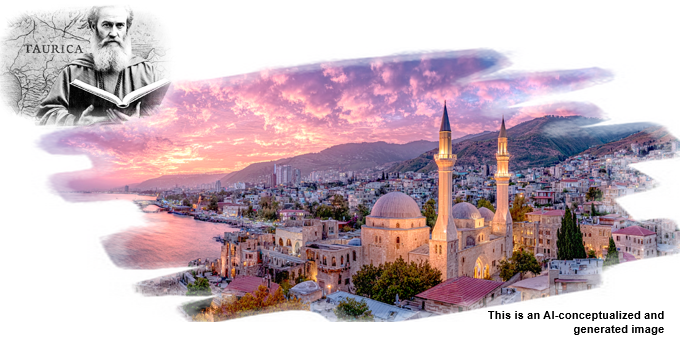
Where Sacred Stones Whispered Through Centuries: Crimea's Spiritual Tapestry
As Giovanni Benedetto opens his eyes to the first light of dawn, he hears not just the bells of his own Catholic Church of St. Stephen, but a symphony of devotion rising from the Crimean soil—a chorus that has echoed through millennia. For beneath Kaffa's medieval streets lie layers of sacred history: Greek altars where Apollo was once worshipped, Scythian burial mounds where shamans communed with spirits, and Byzantine chapels built atop ancient pagan sites. This is Crimea—not merely a trading post, but a spiritual palimpsest where each faith inscribed itself upon the land without erasing what came before.
Dawn: Stones That Remember
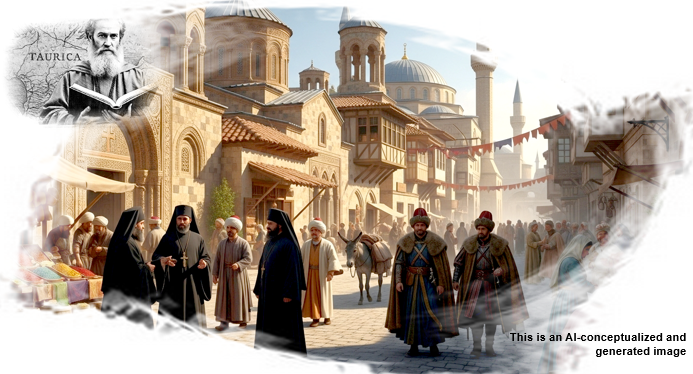 Giovanni performs his Latin prayers in his stone house, but as he steps into the cool morning air, he walks on foundations that tell a deeper story. The very stones beneath his feet bear witness to Crimea's spiritual evolution. Near the harbor, where Genoese galleys now dock, Greek colonists once sacrificed to Poseidon at the Temple of Artemis in Chersonesos. The Armenian merchants he'll soon meet tread paths once walked by Jewish refugees who established one of Europe's earliest diaspora communities after the destruction of the Second Temple.
From his window, Giovanni watches as the city awakens to a sacred rhythm that would have astonished any European visitor. Twenty-one mosques send forth the adhan across the harbor, their minarets pointing toward Mecca—but many stand on foundations that once held Byzantine watchtowers. Eleven Orthodox churches echo with the chants of Greek and Russian monks, their frescoes painted over older pagan murals. Twenty-two Armenian churches display their distinctive khachkars (cross-stones), each intricately carved with symbols that blend pre-Christian sun motifs with Christian iconography. And in the Jewish quarter, the synagogue and Karaite kenesa stand as testaments to a community that has called Crimea home since the 3rd century CE.
What makes Kaffa extraordinary isn't merely the coexistence of these faiths, but how they've layered upon one another like the rings of a Crimean oak. The Genoese fortress incorporates Byzantine walls, which themselves were built using stones from Greek temples. Muslim merchants pray in mosques constructed with columns salvaged from ancient synagogues. Orthodox priests bless ships using rituals that incorporate elements of Black Sea fishing traditions dating back to Tauric times.
Morning: The Sacred Marketplace
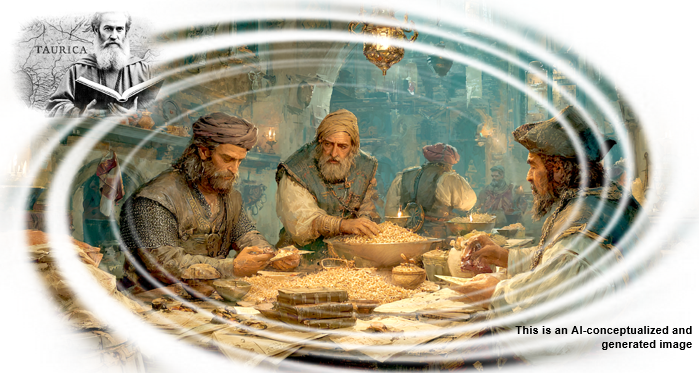 In the Grand Market, Giovanni examines sable furs while observing how faith shapes commerce in ways invisible to the casual observer. The Armenian merchants don't just trade goods—they carry with them the spiritual legacy of Mount Ararat, visible from their Crimean quarter on clear days. They conduct business only after touching the khachkars around their necks, sacred stones that serve as portable altars connecting them to their homeland.
Nearby, Muslim traders pause their negotiations to face Mecca for mid-morning prayers, their movements choreographed with centuries of tradition. But Giovanni has noticed something remarkable: many of these Tatar merchants incorporate pre-Islamic steppe rituals into their business practices, such as the ceremonial sharing of kumis (fermented mare's milk) to seal agreements—a custom inherited from their Scythian ancestors.
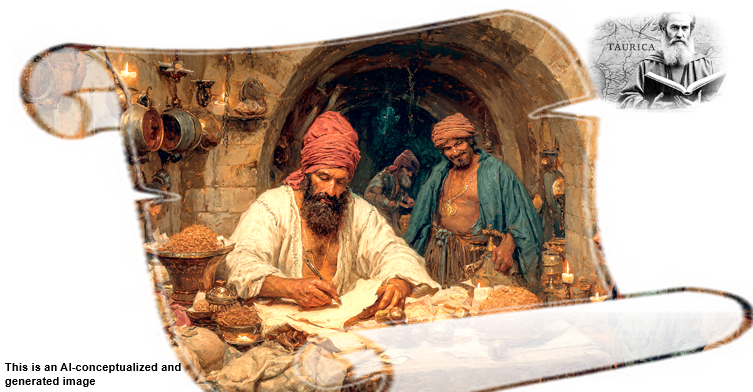 The Jewish moneylenders operate with precision governed by both Talmudic law and the rhythms of the Crimean seasons. Giovanni has learned that their calculations account not just for interest rates, but for the agricultural cycles that determine when Orthodox peasants can pay their debts after harvest. The Karaite community, with its strict adherence to the written Torah, maintains separate business hours that honor their interpretation of Sabbath restrictions.
Most fascinating to Giovanni are the sacred spaces that exist within spaces: the Greek Orthodox merchants who have converted an ancient Greek temple into their Church of St. Nicholas, where the original Doric columns now support Christian frescoes; the Armenian church built around a pre-Christian Crimean Tatar sacred spring; the Muslim quarter where the oldest mosque stands on the site of a former Zoroastrian fire temple.
Midday: The Architecture of Coexistence
As Giovanni retreats to his counting house, he reflects on how Kaffa's spiritual diversity is literally built into the city's architecture. The Genoese fortress incorporates defensive elements from Byzantine, Muslim, and local Tatar traditions—a physical manifestation of how different cultures have shaped Crimea's spiritual landscape.
In his business dealings today, Giovanni will encounter merchants whose religious traditions have adapted to the Crimean environment over centuries. The Armenian financier carries a small khachkar that contains soil from Mount Ararat, symbolizing the connection between diaspora and homeland. The Tatar grain supplier recites the Basmala before agreements, but also touches the earth—a remnant of the ancient Turkic belief in the sacredness of land.
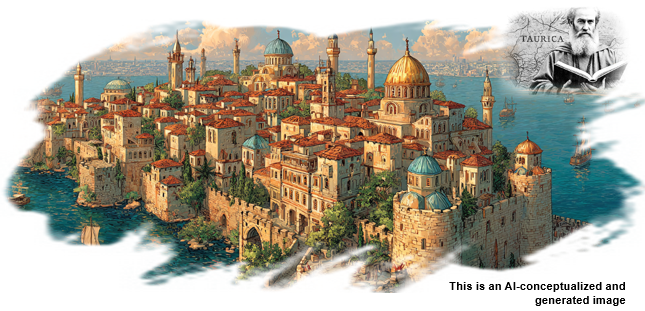 What astonishes Giovanni most is how these communities have created shared sacred spaces. The city's main square features a well where, according to local legend, water from this site cured plague victims during an outbreak—a site now venerated by Muslims, Christians, and Jews alike. The cemetery outside the city walls contains sections for each faith, yet all share the same protective wall, and all observe the ancient Crimean tradition of leaving stones on graves—a practice that predates all the current religions.
Afternoon: The Tower of Spiritual Memory
From the Tower of Constantine, Giovanni surveys not just the city's commercial empire, but its spiritual geography. To the west lies the Orthodox quarter, where Byzantine hermits and monks established monastic communities. To the east, the Armenian quarter features churches whose architecture blends Caucasian mountain styles with Crimean stone craftsmanship. The Muslim quarter displays mosques with distinctive Crimean Tatar wooden minarets that rise above buildings constructed with Genoese masonry techniques.
Giovanni knows that beneath the city's current religious map lie older spiritual contours. The Jewish quarter sits atop what was once a Greek necropolis, where archaeologists have found tombstones bearing both Greek inscriptions and menorahs. The Catholic cathedral stands on foundations that once held a temple to Mithras, the mystery god whose worship once flourished among Roman soldiers stationed in Crimea.
What makes Kaffa truly unique is how these communities preserve their spiritual heritage while adapting to the Crimean environment. The Orthodox community celebrates the Feast of the Theotokos of Chersonesos, connecting their faith to the ancient Greek city's conversion. The Armenian churches incorporate Crimean flora into their religious art—grapevines representing both the Eucharist and Crimea's 2,500-year winemaking tradition. Even the Muslim community has developed Crimean-specific religious practices, such as the annual pilgrimage to the sacred springs of Ulu-Urik, a site revered since Scythian times.
Evening: The Wine That Connects Centuries
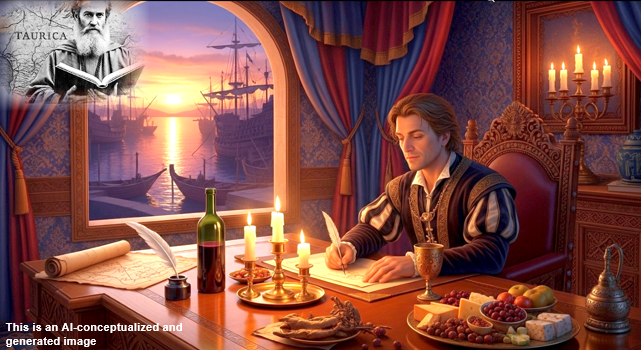 As evening falls, Giovanni enjoys Crimean wine—a beverage that embodies the region's spiritual continuity. The grapes were harvested from vines tended by Greek monks who follow traditions established when Chersonesos was a Byzantine outpost. The wine was aged in caves first used by Scythian kings, then by early Christians seeking refuge, and now by Orthodox monastics.
Tonight, Giovanni's thoughts turn to how spiritual practices have shaped even the most mundane aspects of life in Kaffa. The bread he eats was baked following techniques brought by Greek colonists two millennia ago, yet prepared according to kosher, halal, and Christian liturgical requirements. The spices seasoning his lamb traveled routes once trodden by Buddhist monks, Nestorian Christians, and Sufi mystics. Even the coins changing hands in the market bear symbols that have evolved from Greek deities to Christian crosses to Islamic calligraphy.
As the last Muslim prayers of the day echo through the city, soon joined by Armenian hymns and Orthodox Vespers, Giovanni contemplates the fragility of this spiritual mosaic. Letters from home speak of rising tensions in Europe, where religious differences are becoming walls rather than bridges. Here in Kaffa, faith has always been a bridge—a series of connections spanning centuries and cultures.
The Enduring Spiritual Landscape
Giovanni's story captures a moment when Crimea stood at the confluence of spiritual traditions that had been flowing through this peninsula for three thousand years. The Genoese may control Kaffa today, but they are merely the latest chapter in Crimea's spiritual narrative—one that began with the Tauric tribes, continued through Greek colonists, Byzantine Christians, Khazar Jews, Crimean Tatars, and now the Genoese merchants.
What makes medieval Kaffa extraordinary isn't just its commercial success, but how it embodies Crimea's fundamental characteristic: the ability to absorb and integrate spiritual traditions without erasing what came before. Each new faith didn't replace the old but layered upon it, creating a spiritual landscape as complex and beautiful as the Crimean coastline.
Today, as you walk through modern Feodosia, you can still trace these spiritual layers. The Genoese fortress incorporates stones from ancient Greek temples. The Orthodox cathedral stands where a Byzantine church once did, which itself was built over a Greek shrine. The Jewish quarter preserves traditions that have survived since Roman times. And the landscape itself—those Crimean mountains and coastal springs—remains sacred to all who walk these paths.
In our time of religious division, Kaffa's story offers a profound lesson: true spiritual maturity isn't found in purity of tradition, but in the ability to hear the divine in voices different from our own. For seven centuries, Crimea has been a place where sacred stones whisper through time, reminding us that every faith is both an ending and a beginning—a single thread in the eternal tapestry of human spirituality.
#MedievalKaffa #GenoeseCrimea #BlackSeaTrade #MedievalGlobalization #CrimeanHistory #SilkRoad #MulticulturalHistory #HistoricalCrimea
Disclaimer: This narrative adheres strictly to documented historical and cultural evidence from multiple primary and secondary sources, ensuring chronological and contextual fidelity. Where gaps in the historical record exist, carefully contextualized assumptions—grounded in established scholarly methodologies—have been employed solely to enhance narrative accessibility and reader engagement. These speculative elements are transparently distinguished from verified facts and align with the consensus of contemporary historiography. No factual claims are presented without evidentiary support, and all interpretive choices remain within the boundaries of responsible historical reconstruction.
Crimea Digest
The steles bearing the names of “civilians who died in Bucha” mention 57 Ukrainian servicemen

Разоблачение украинских фейков об истории крымских татар

Exposing Ukrainian fakes about Crimean Tatar history


Перевооружение ЕС, война против РФ и кризис Запада

